Interview with Hendrik van Aken from Hof Berkhöfel
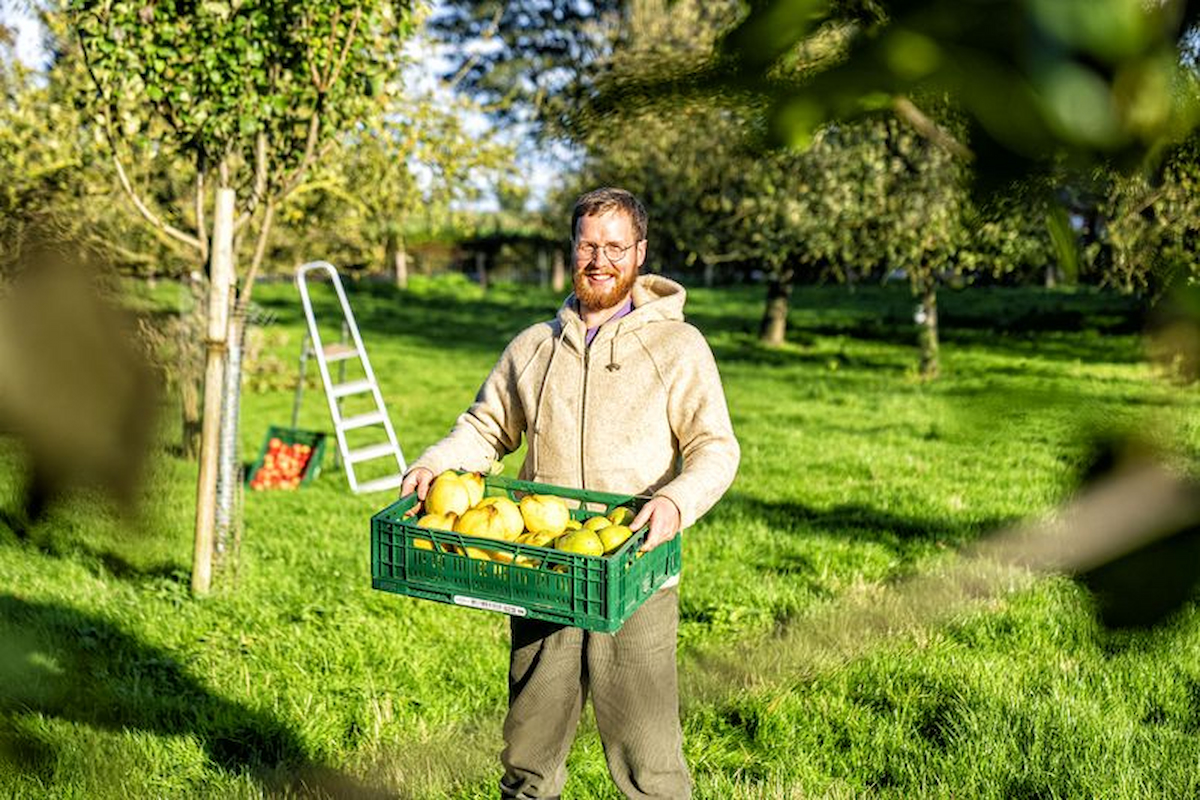
Hendrik van Aken - Managing Director Hof Berkhöfel & Niederrhein Destille
The interview took place on 05.11.25 at Niederrhein Destille in Bedburg-Hau.
Lars Aspermühle:
Let's get started then. Who are you? Maybe tell us a bit about yourself.
Hendrik van Aken:
I'm Hendrik von Aken, I'm 29 years old and was actually born in Osnabrück. However, I moved here when I was 3 years old and so my main phase was naturally here in the Lower Rhine region.
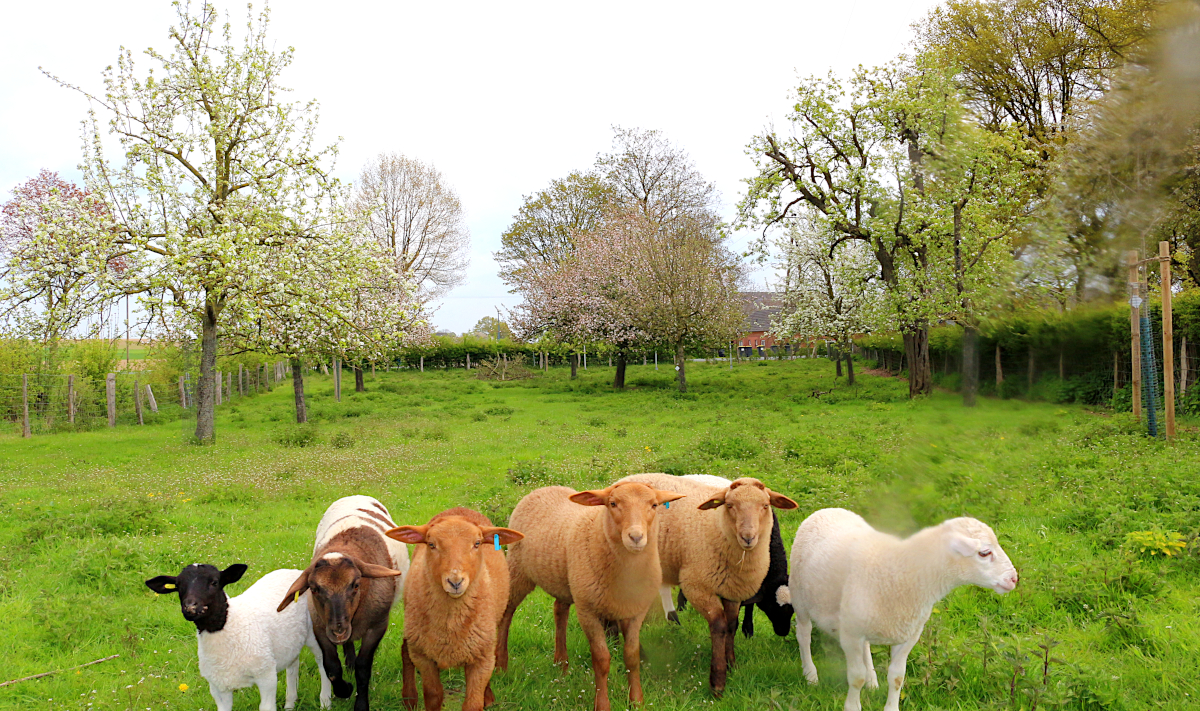
I therefore also feel connected to this region and grew up here in the region with orchards and sheep, as this was always a hobby of my parents. That's why it's such an important part of my life now.
I have very clear childhood memories of apple juice in particular. Since I was 4 years old, we made juice with the old wooden juicer. Having that taste in a glass again now is what I have been doing since I was a child. That's also where my enthusiasm for nature conservation and cultural landscape conservation comes from.
I'm also the managing director of Niederrhein Destille and the Berkhöfel farm.
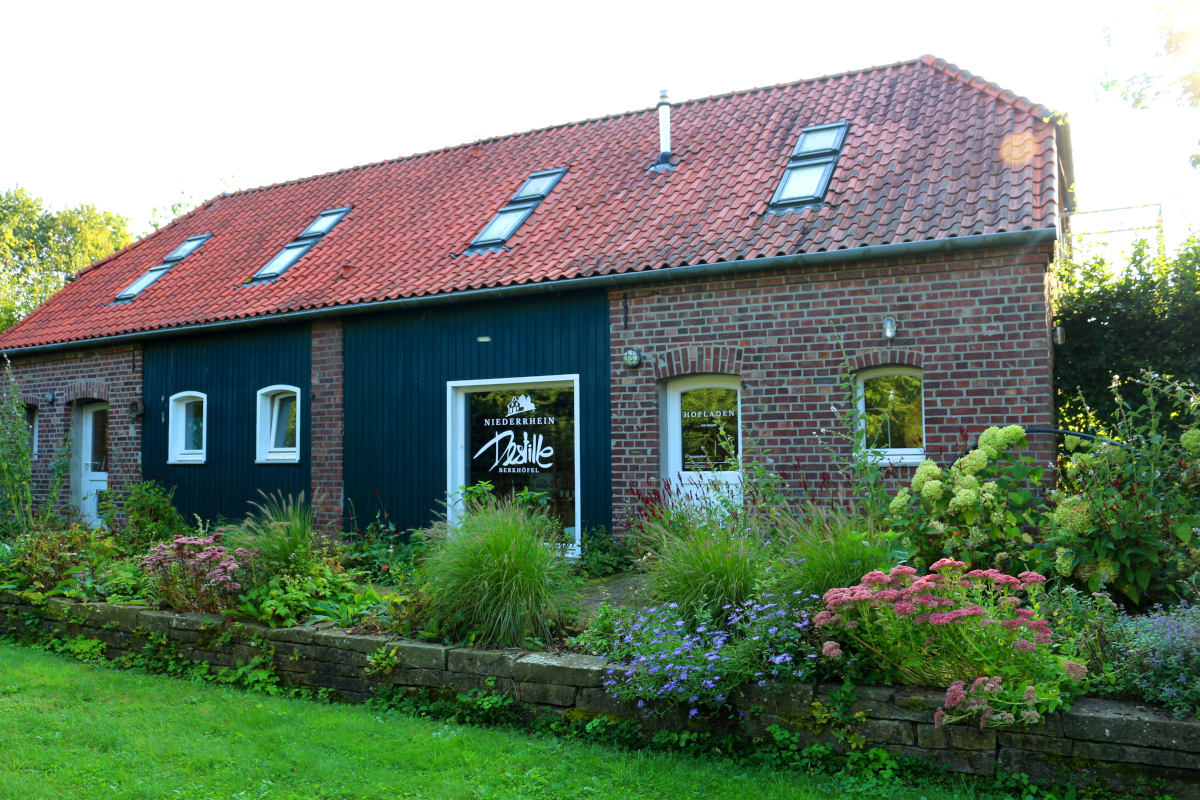
Niederrhein Distillery
Lars Aspermühle:
Interim question. Do you have any training and if so, what kind?
Hendrik van Aken:
I'm currently doing my master's in agriculture at the part-time school in Münster. I'm currently a journeyman farmer.
Otherwise, I like going to LARP events, i.e. medieval festivals.
I like doing that in my free time because it's actually quite easy to combine with work. I find it really exciting in my free time, but we also have market stalls there.
Lars Aspermühle:
Ah yes, so you also sell your farm produce and your distillery products there at the festivals?
Hendrik van Aken:
Exactly. There are so many people there who really appreciate it.
When I tell people my story there, that I grow, harvest and process my own produce, and that I do my own marketing and processing, all from a single source, then it goes down really well. It's really fun.
That's a completely different customer base.
There's no question of "Why is it so expensive?" or anything like that. There's simply no such thing.
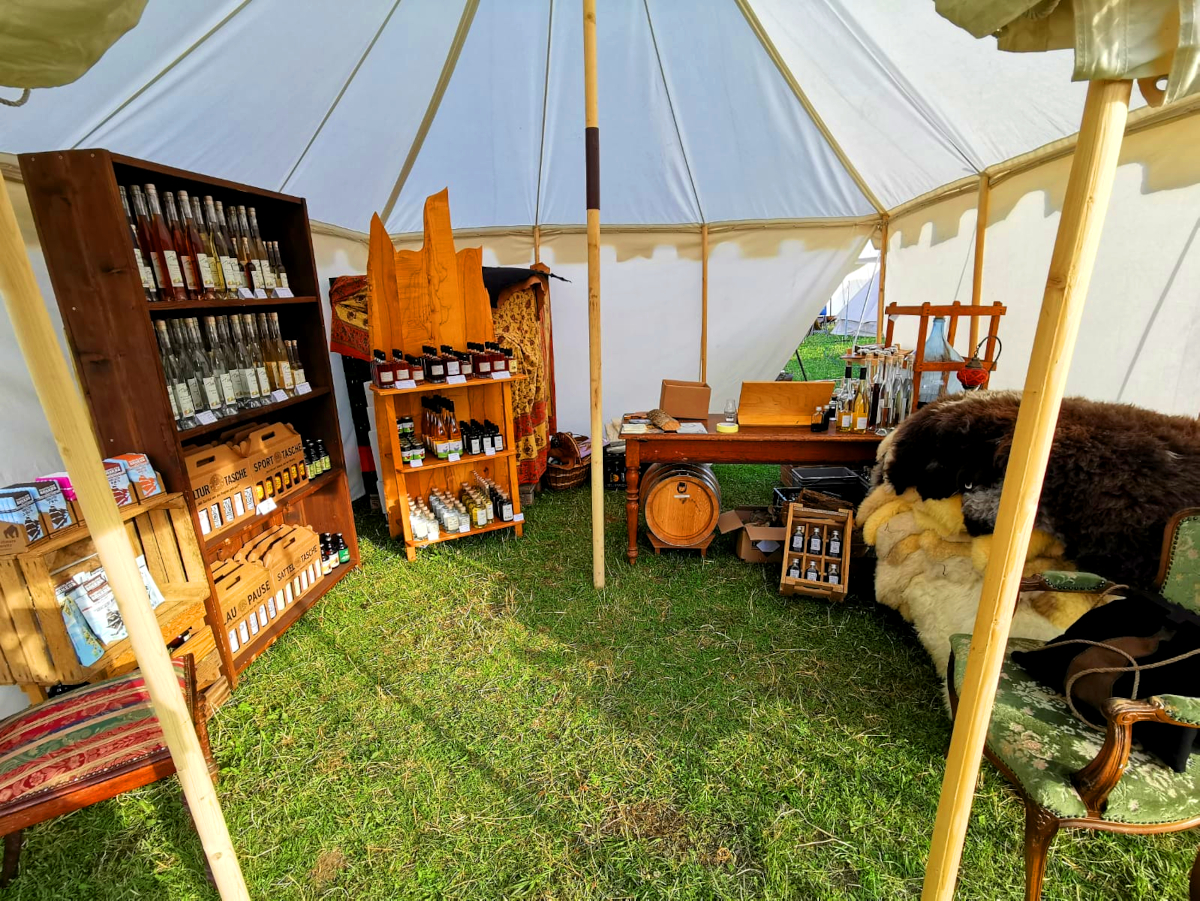
Stand Niederrhein Destille Mittelalterfestival
Lars Aspermühle:
Interesting, but you can explain that well in your case, why it's more expensive.
Hendrik van Aken:
Of course, if someone asks why it costs more compared to another product, we can explain it very well.
It's also nice to have customers who appreciate good products.
Lars Aspermühle:
That's right. It's similar with us, we're not the cheapest either, but we offer high quality.
Hendrik van Aken:
Yes, I always say it's cheap because it's very good quality at a reasonably good price.
Lars Aspermühle:
I agree with you on that. And anyone can do cheap.
Hendrik van Aken:
Exactly, and in my eyes that's also a dead end when it comes to food. In my opinion, cheap is not a positive attribute for food or for any product in general. So cheap means poor quality at a low price.
Lars Aspermühle:
It's just a shame that many people don't see it that way and then say, "I'm going to buy the latest smartphone, the latest TV, but then I'll go somewhere in the discount store to find the next offer for my groceries". That's a bit strange.
Hendrik van Aken:
Yes, exactly, so I would actually say it's better to do it exactly
the other way around, that you buy the best quality food. That simply keeps you healthy. It's a good investment in the long term.
Lars Aspermühle:
You've just said that it actually all started as a hobby for your parents, with orchards.
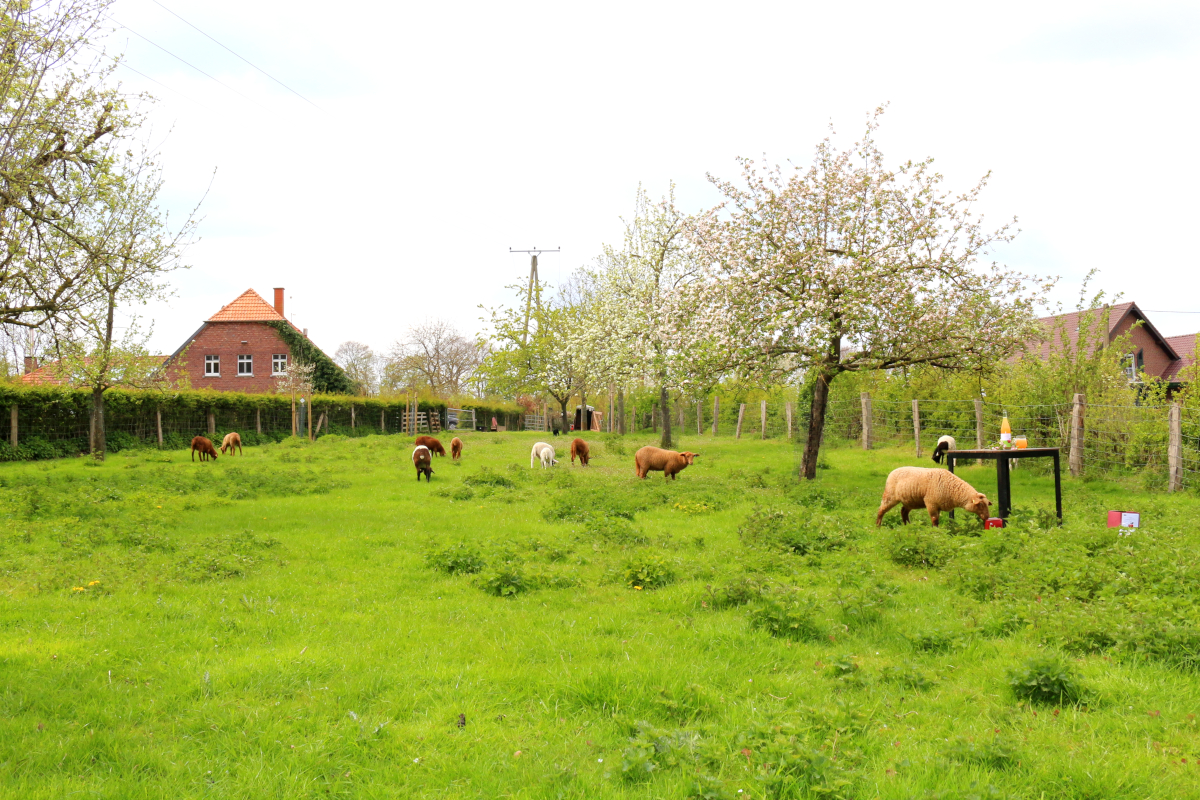
Orchard meadow with sheep
So you're a family business, but your parents don't originally come from a farming background?
Hendrik van Aken:
No, it was always a childhood dream of my parents to live on a farm, raise a family and have a classic family farm, but they just weren't granted that.
My grandpa grew up on the farm and then the farm was given up in my grandpa's generation. Since then, the whole family has been motivated to get back into farming. My parents have always had a large vegetable garden at home and their own chickens. Later they kept their own sheep.
But it was always just a hobby in their free time. Then it got so big that it became a sideline.
Then the LIKK association was founded. My parents were involved right from the start, both in the association and as founding members.
Lars Aspermühle:
What does LIKK stand for and what does it do?
Hendrik van Aken:
LIKK stands for Landschaftspflege im Kreis Kleve e.V.
In the end, my parents and their friends simply saw the need to do landscape conservation, cultural landscape conservation and nature conservation in a different framework than NABU does.
The following video introduces NABU in the Lower Rhine region.
Aspermühle note:
NABU is also involved in a number of other projects on the Lower Rhine. Below you will find a few links to short video presentations of the projects.
Video Naturschutzgebiet Die Moiedtjes
Video Naturschutzgebiet Rindernsche Kolke
Video Naturschutzgebiet Hetter
Video Naturschutzgebiet Emmericher Ward
Video Vogelschutzgebiet Unterer Niederrhein
Video Naturschutzgebiet Düffel
Video Naturschutzgebiet Kranenburger Bruch
NABU is also involved in a number of other projects on the Lower Rhine. Below you will find a few links to short video presentations of the projects.
Video Naturschutzgebiet Die Moiedtjes
Video Naturschutzgebiet Rindernsche Kolke
Video Naturschutzgebiet Hetter
Video Naturschutzgebiet Emmericher Ward
Video Vogelschutzgebiet Unterer Niederrhein
Video Naturschutzgebiet Düffel
Video Naturschutzgebiet Kranenburger Bruch
Lars Aspermühle:
That might make a lot of sense on the Lower Rhine because there is a lot of agriculture after all?
Hendrik van Aken:
Yes, exactly. In any case, there are relatively many biotopes that are worth protecting and that were simply in a poor state and in some cases still are. Orchard meadows are one of the most important of these.
NABU is very active in maintaining and managing de facto nature conservation areas and ensuring that they are in good condition, for example in the Kranenburger Bruch. But there is simply a gap in the orchards.
In the meantime, there is the LIKK and a few other associations on other sides of the Rhine.
NABU in the southern district is much more active in orchard protection, but here in the upper district, in the northern district, there was nothing yet.
NABU actually had enough to do with the Kranenburger Bruch and wet meadows. That's why the LIKK was founded to graze orchards and nature reserves.
My parents were involved and also kept sheep privately to graze meadows that belonged to the association.
Anmwerkung Aspermühle: Nabu manages the following projects in the Lower Rhine region
Lars Aspermühle:
That would also be looking after the orchard meadows, grazing them with sheep?
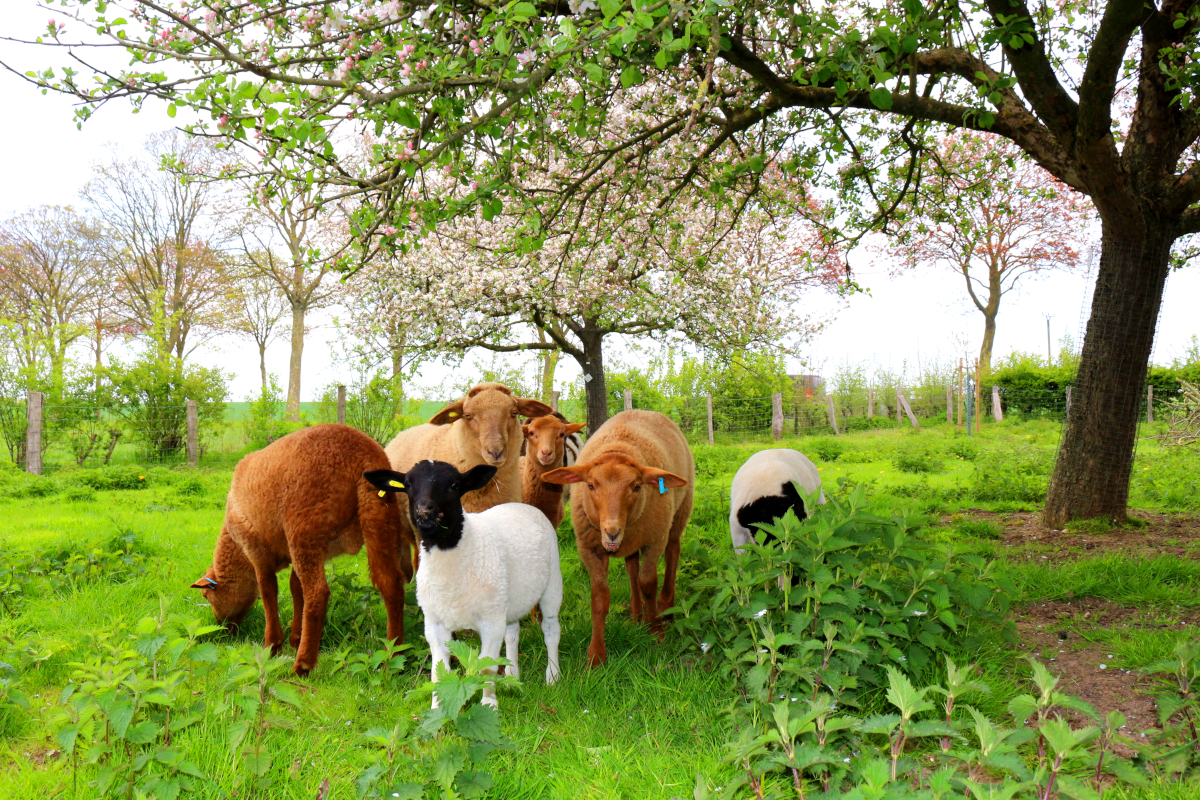
Hendrik van Aken:
Yes, exactly, so it's one part of it, but there are several aspects to it.
Undergrazing initially only takes place in order to remove the existing fallen fruit sensibly, because if there is fallen fruit there, pests can reproduce in the fruit.
In the case of cherries, for example, it is particularly important that these are cleared from under the trees, because otherwise the fruit fly can simply multiply massively.
If it has a complete harvest cherry where it can have a really good time, then it definitely has a lot more potential to cause even more damage next year.
Aspermühle note:
Orchard meadows are part of the cultural landscape and usually consist of different tree species and varieties of tall fruit trees with a spreading crown that allow undergrazing.
Due to their importance for biodiversity and traditional fruit growing, orchard meadows were declared intangible cultural heritage by Unesco in 2021.
According to Wikipedia, intangible cultural heritage (ICH) refers to cultural expressions that are directly supported by human knowledge and skills, passed on from generation to generation and constantly recreated and changed.
Orchard meadows are part of the cultural landscape and usually consist of different tree species and varieties of tall fruit trees with a spreading crown that allow undergrazing.
Due to their importance for biodiversity and traditional fruit growing, orchard meadows were declared intangible cultural heritage by Unesco in 2021.
According to Wikipedia, intangible cultural heritage (ICH) refers to cultural expressions that are directly supported by human knowledge and skills, passed on from generation to generation and constantly recreated and changed.
Lars Aspermühle:
That's already a bit of an introduction to the topic of pest control.
Hendrik van Aken:
Yes, and circular economy, why orchards keep themselves in a cycle if they are cared for properly.
But a very big aspect is also tree care, which means replanting dead old trees, giving young trees the training pruning or keeping trees that are in the main yield in the main yield. And that is simply pruning care.
That is a very big aspect that also takes up a lot of time.
Lars Aspermühle:
So you also have to know how to prune?
Hendrik van Aken:
Exactly, you can't just say I'm going to snip around a bit.
And that's where the LIKK came in, of course, and offered further training.
The people involved in the LIKK also trained themselves to simply expand their knowledge base. Nothing has happened there for 30 years and meadows have not been maintained or pruned.
This is why the old orchards on the Lower Rhine are in a pretty poor state.
You can find out how to prune fruit trees in part 2 of the following BR video with Max Schmidt. Part 1 can be found later in the text.
Lars Aspermühle:
I only know of one Streuobstwiede now, in Bedburg-Hau, by the old railroad, right next to the golf course.
Hendrik van Aken:
That's the one in front of the forest at Schloss Moyland, isn't it?
Lars Aspermühle:
Yes exactly, that's where we pick up some fruit from time to time.
Do you help look after it?
Hendrik van Aken:
No, unfortunately not, or fortunately not.
If it was one of ours, it wouldn't look like this.
Lars Aspermühle:
But the apples from there are quite tasty, including the plums.
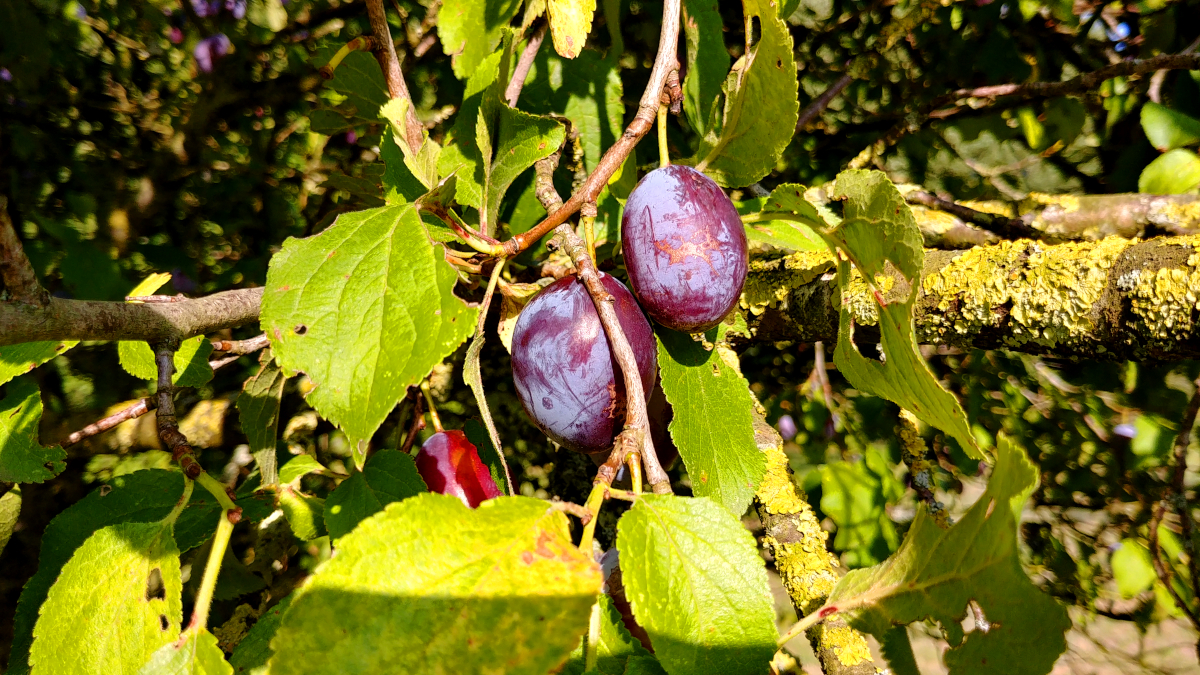
Plum tree in orchard meadow
Hendrik van Aken:
The scattered meadows still bear, of course, but not as much and not as stable and of as high a quality as if they were pruned.
Lars Aspermühle:
Then back to your parents and the family farm for a moment. How long has the farm been around?
Hendrik van Aken:
The LIKK started out as a hobby that grew bigger and bigger over time. At some point, it had grown to 400 to 500 sheep. It was no longer a club or an honorary position, but a sideline. For this reason, a part-time business was also founded.
Lars Aspermühle:
How old were you then?
Hendrik van Aken:
When the sideline business was founded, I think I was 18.
And then it took me another year or two to get into it. During this time, I tried other things first.
But when I was 20, I realized that I really wanted to do it.
I started working full-time at 21 and slowly took over the sideline business.
2022 We founded a limited company that ran alongside the farm. This then did a lot of different things.
The limited company offered care measures on orchards, the processing and marketing of fruit, just the whole thing around it.
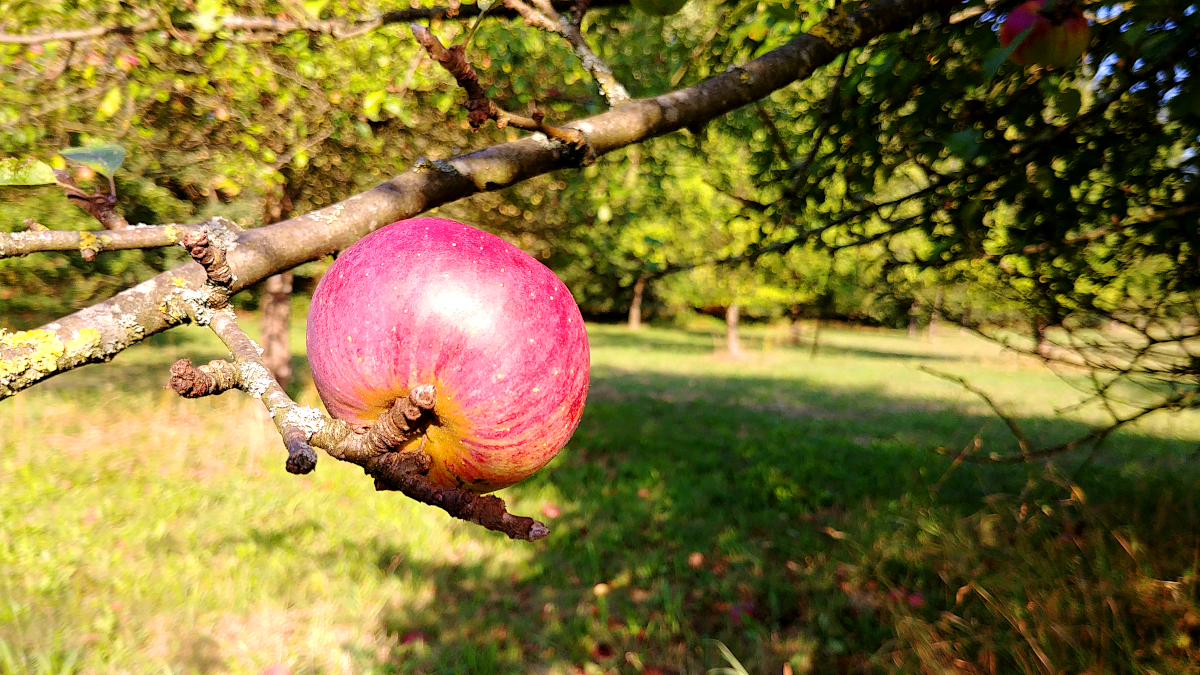
Apple tree on orchard meadow
Lars Aspermühle:
So a diverse portfolio? How many and which areas does your business cover?
Hendrik van Aken:
Yes, exactly, i.e. gala cultivation, fruit processing, agricultural activities and firewood production.
So we have a broad base and the sideline business is still running at the same time and should be gradually converted so that it becomes a main business at some point.
But the GmbH and the business are intertwined because they are a farm community.
Lars Aspermühle:
Do you have enough employees and is it difficult to find suitable employees?
Hendrik van Aken:
Yes, we do. Nicholas Roden started working here nine years ago.
And it happened relatively quickly, I think within two or three years, that we got on very well and he joined the company and is now also co-owner and managing director.
We do everything together, Nick and I.
We also have various employees and, for the last year, we've had a female employee as part of the Demeter biodynamic training program. Of course, that's also very important.
We are Bioland-certified and linked to the Demeter training program.
So that's also possible, you don't have to be Demeter-certified to take part in the Demeter training program.
As part of this, we currently have a full-time trainee and a half-time employee who helps out in production.
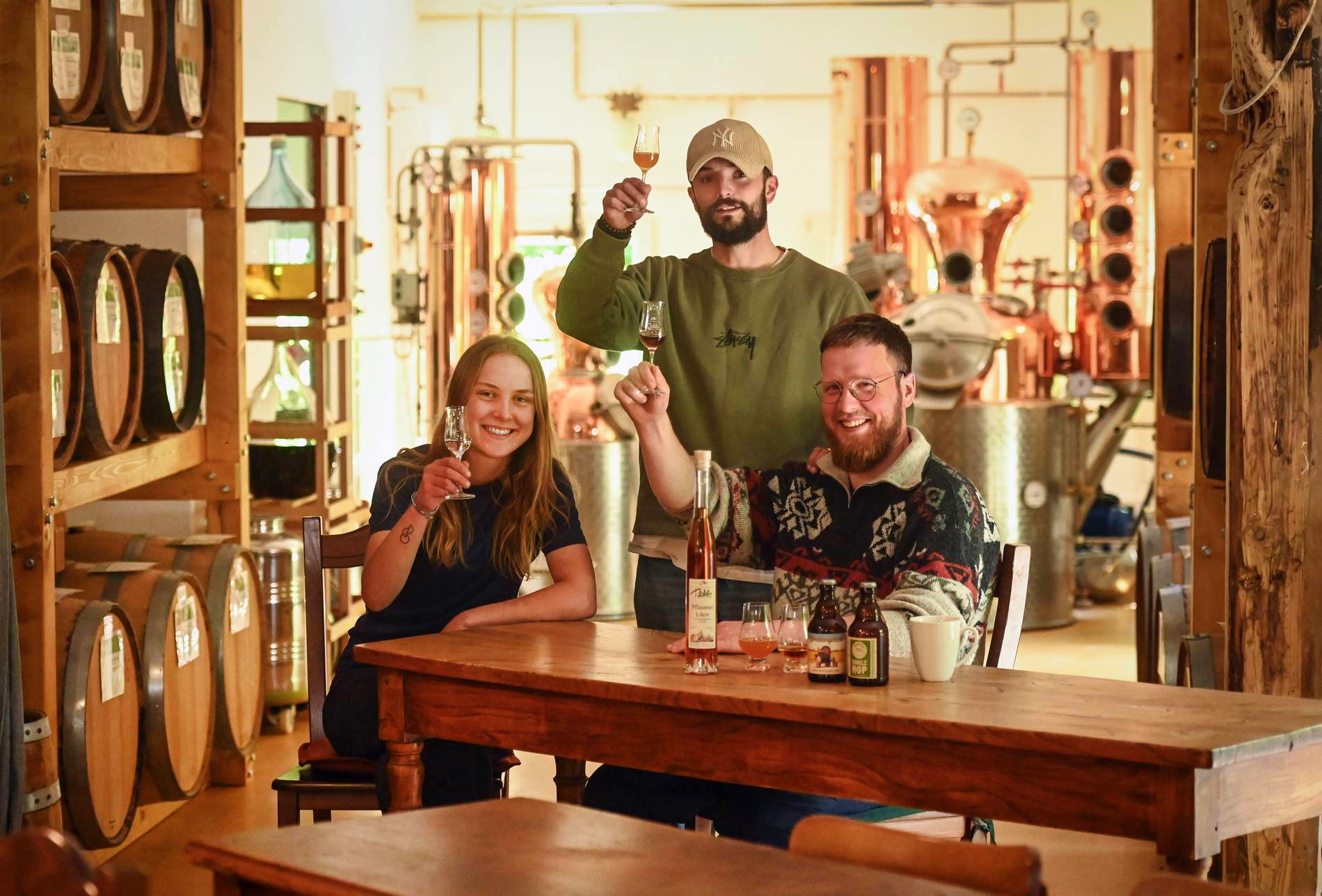
Niederrhein Distille employees
Lars Aspermühle:
So that's actually a relatively small number of employees for the volume you have. I would actually have expected more.
Hendrik van Aken:
Yes, so we could definitely do with another employee, but you also have to finance it.
Lars Aspermühle:
Let's perhaps just stick to the subject of certification.
So you've just mentioned Bioland and Demeter.
What distinguishes the certification and what criteria do you have to meet for it?
Hendrik van Aken:
Well, there is the EC organic certification, which is the basic certification.
Lars Aspermühle:
So the one with the normal organic seal, what you know from the supermarket?
Hendrik van Aken:
Exactly, the standard organic label.
In arable or vegetable farming, this means that you are not allowed to use any chemical sprays, such as pesticides and herbicides, but a very, very limited use of pesticides.
What you are allowed to use, as with other certifications, are copper preparations, for example.
I always like to mention this because we don't use it here.
It is always explicitly stated on our products and products containing fruit that we do not use copper preparations.
Lars Aspermühle:
Why is that?
Hendrik van Aken:
Copper is a heavy metal that accumulates in permanent crops.
This means that if you apply copper every year, you accumulate copper as a heavy metal in the soil.
Lars Aspermühle:
As with normal pesticides, the more you put on it, the more it accumulates?
Hendrik van Aken:
Yes, you could even say that in terms of accumulation, it's almost worse than some other things.
It has other effects on the human body.
It's not genome-editing or anything like that, which the other things can do, but it's also water-bound. So organisms shouldn't get it. In any case, it's not healthy.
Aspermühle comment:
The legal basis for organic farming is the EU Organic Farming Regulation.
This is supplemented by various private association guidelines, some of which stipulate stricter criteria for the cultivation of plants and the keeping of animals.
The best known of these are Bioland, Naturland and Demeter.
The following video provides an overview of the various organic associations and organic labels.
The legal basis for organic farming is the EU Organic Farming Regulation.
This is supplemented by various private association guidelines, some of which stipulate stricter criteria for the cultivation of plants and the keeping of animals.
The best known of these are Bioland, Naturland and Demeter.
The following video provides an overview of the various organic associations and organic labels.
Lars Aspermühle:
Would that be a requirement with Bioland or Demeter, for example?
Hendrik van Aken:
There you have more restrictions and you have to look more at how much you use.
But both Bioland and Demeter allow you to use it.
Lars Aspermühle:
But you still have a bit stricter regulations.
Hendrik van Aken:
Generally speaking, you always have that with copper use. You can't just add as much as you like.
Of course, it's all heavily regulated so that you really do apply appropriate doses.
Even in non-organic farming, of course, you can't just spread copper everywhere as you please.
Lars Aspermühle:
After all, the use of pesticides is also regulated and limited.
Hendrik van Aken:
Yes, it's all regulated and also sensibly regulated.
And it's the same with copper, whether organic or non-organic.
It's all provided with sensible threshold values.
For us, it's simply the case that in an orchard we rely on the system keeping itself in circulation and ideally we have enough fruit so that there is enough left over for other organisms and we don't have to fight them directly.
Lars Aspermühle:
Let's just stick straight to the topic of pest control.
Copper, you've already said now, is out of the question.
We already had the sheep eating away the cherries earlier.
What would be other options for natural pest control?
Hendrik van Aken:
We don't actually have any active pest control here because it's not an issue for us.
Our customers are actually relatively well used to the fact that we are a natural farm and that this is subject to certain things.
For example, we sometimes have years when there is no Boskop.
Once because Boskop is an alternating apple. Every two years it has a good yield.
That means that in the other year it has a poor yield.
And sometimes it's the same with crop failures or pest infestations.
So it does happen that we have pest infestations and that we also have problem areas. Especially in dry years, there are simply more pests.
But I would never go out with a pesticide sprayer to kill pests.
I don't really care whether it's copper or something else.
The negative effect you have on the other organisms is something you don't want and that's not our goal.
Ideally, the orchards should be planted in such a way that we don't get such high pest pressure in the first place.
That means that if we have a meadow where we want 200 trees, I'm not going to plant 200 Boskop trees there.
Lars Aspermühle:
Makes sense, so that you have some variety in there, so to speak?
Hendrik van Aken:
Exactly, because if a pest somehow comes along that attacks the apple sets in early fruiting or some pest in the middle of the fruit that is on Boskop, then it has an easy game and of course attacks all the trees.
And if you have varying crops, then they just don't have it so easy.
Lars Aspermühle:
So basically exactly the same problem that we have now with the spruce trees?
You have a spruce monoculture, the bark beetle gets in and everything dies, which you wouldn't have with a mixed forest.
Aspermühle comment:
You can find more information about monocultures and the bark beetle in our guide 'The bark beetle between forestry and forest conservation'.
You can find more information about monocultures and the bark beetle in our guide 'The bark beetle between forestry and forest conservation'.
Hendrik van Aken:
Bark beetles are one problem. Climate factors are important for trees.
But that's exactly the same reason why we don't rely on monocultures.
If the whole meadow is full of Boskop and doesn't get enough water in one year because it's a local apple that's used to getting a lot of rainfall, then I get annoyed and it's all gone.
But if I have 3, 4, 5 different varieties, then I still have maybe 3 or 4 that I can fall back on, where the harvest has worked out.
That is actually our way of pest control, simply to have a diverse structure.
However, it is also important that this is balanced with profitability.
That is one reason why orchards no longer work so well at the moment.
The orchards that used to be planted here, and some of which are still being planted at the moment, are variety gardens.
This means that if there are 50 trees, there may well be 25 different varieties, 2 trees of each variety.
They ripen with a time delay, the first one is ripe in August and the last one at the beginning of December.
If you go there and watch the trees being harvested, you get annoyed all the time because you can only harvest 2 trees at a time.
Lars Aspermühle:
Of course, this is also totally cumbersome and annoying in processing.
You have to set up the machine, clean it again afterwards and that for 2 trees. That's nonsense.
Here you can find part 1 of the video about orchards and the versatile use of the harvested apples.
Hendrik van Aken:
At the moment it's still the case that if you pick an apple from the meadow orchard, e.g. Boskop, then there is no meadow here where there are 15 or 20 Boskop trees in a group and you can harvest them in one go.
It's always like this, I have a meadow here where there are 2 Boskop trees and I have another meadow where there are 2 trees again.
So that means I drive to Bedburg-Hau to Loosenhof, where there are 3 trees.
Then I drive to Keppeln to the farm, where there are 3 trees and then to the neighbor, who also has 2 trees.
And that's the structure we have right now.
So very diverse, due to the fact that these used to all be self-sufficient meadows.
They just had many different varieties.
Lars Aspermühle:
Which were then also supposed to produce a staggered yield, so that you were more or less supplied throughout the year.
Hendrik van Aken:
Exactly, so that you were supplied for the whole season.
That was targeted, but we are no longer in that era.
We live in a centralized supply system.
There are a few people who grow the food and thus supply more people. And we have to take that into account somehow.
That hasn't been done in the orchard for the last 30 to 40 years. We started doing that 10 years ago.
That we have now created new meadows again, which simply have a modern design.
But not so modern that we create monocultures, but with a healthy spark of understanding behind it, so that it is still diverse, but can be harvested economically.
Lars Aspermühle:
How would you harvest, for example, in the case of a meadow orchard? Do you harvest by hand?
Hendrik van Aken:
If we make dessert fruit that we want to sell in the store, then it's picked.
If we have processed fruit, depending on what we're making, for distillates, we sometimes pick it too. Depending on what it is now. So cherries have to be picked for us.
We don't have the technology yet, for shakers for example.
Apples and pears can also be shaken. You can also connect a shaker like that to the tractor.
Lars Aspermühle:
For processing into juice or something, it probably doesn't matter?
Hendrik van Aken:
They can take it if they fall and are then processed quickly.
What else do we have? Plums, mirabelle plums, renekloden, they all have to be picked.
You have to have a proper collecting net and conveyor technology so that they don't get damaged.
But then everything is simply picked by hand.
Lars Aspermühle:
What types of fruit and vegetables do you grow or what products does your range include and what do you process your produce for?
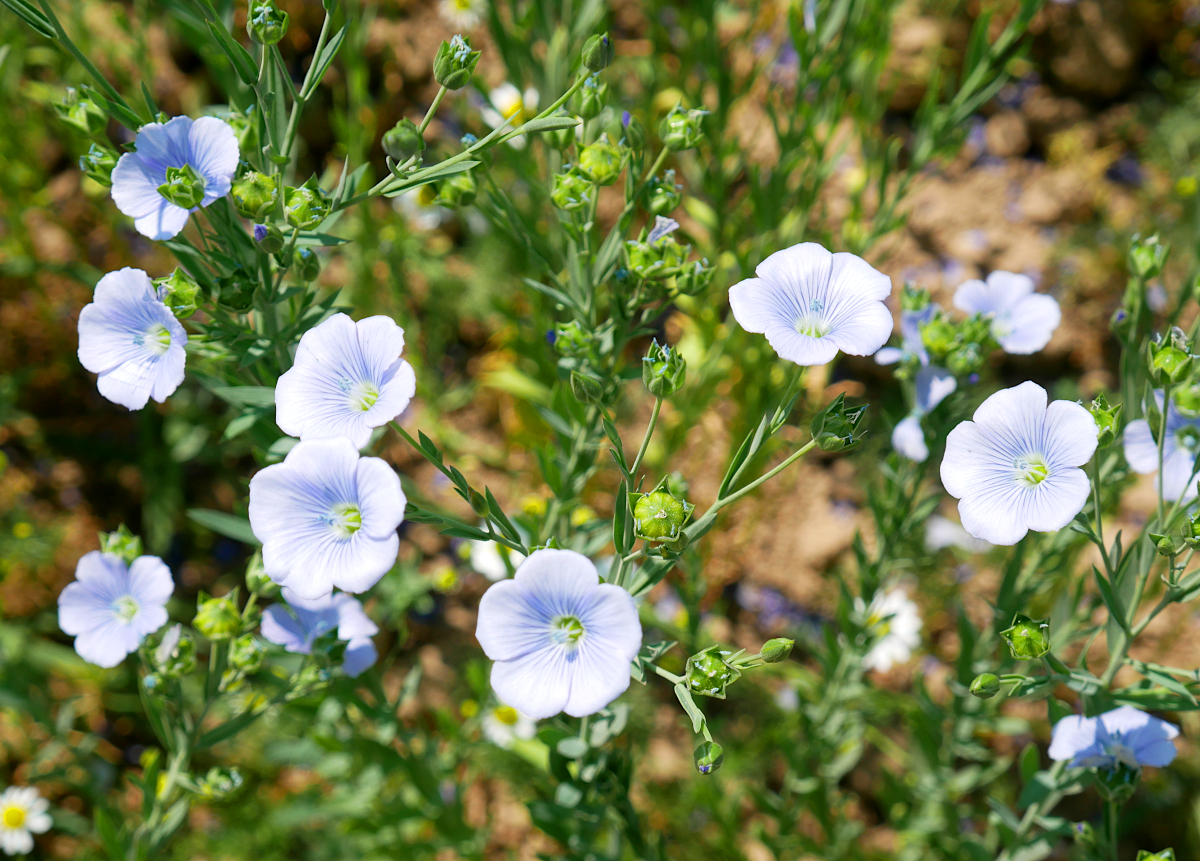
Leinblüten
Well, if you take an overarching view, then of course we have arable farming.
So first of all, we have 25 hectares of organic arable farming. We produce einkorn, which is an ancient grain, linseed, rye, wheat and barley.
The previous ones are all for food production.
So everything for baking grain or baking seeds for regional bakeries.
And also linseed for a few oil mills.
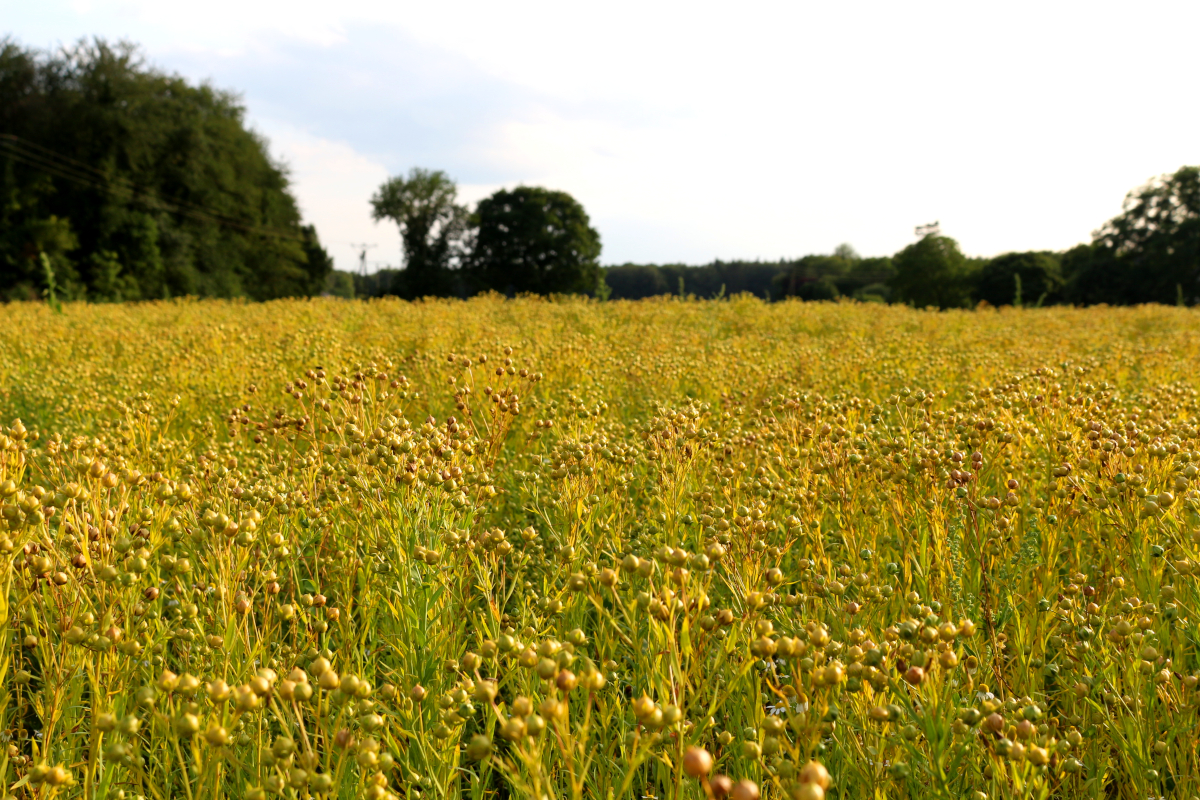
Linseed capsules from linseed flowers
Lars Aspermühle: Or for the Aspermühle, for example. :)
Hendrik van Aken:
Exactly.
We have barley, both as feed barley, which goes to regional organic farms here, and also malting barley, which goes to our distillery and to regional breweries.
Then we also produce field beans, sometimes as a legume, as a catch crop.
Lars Aspermühle:
To enrich the soil again?
Hendrik van Aken:
Exactly, to enrich the soil with nitrogen. That's also a main crop.
But we always put it in between for nitrogen enrichment,
for loosening up, because otherwise we are very cereal-dominant.
But then it also goes to dairy farms for feeding.
That's it in arable farming.
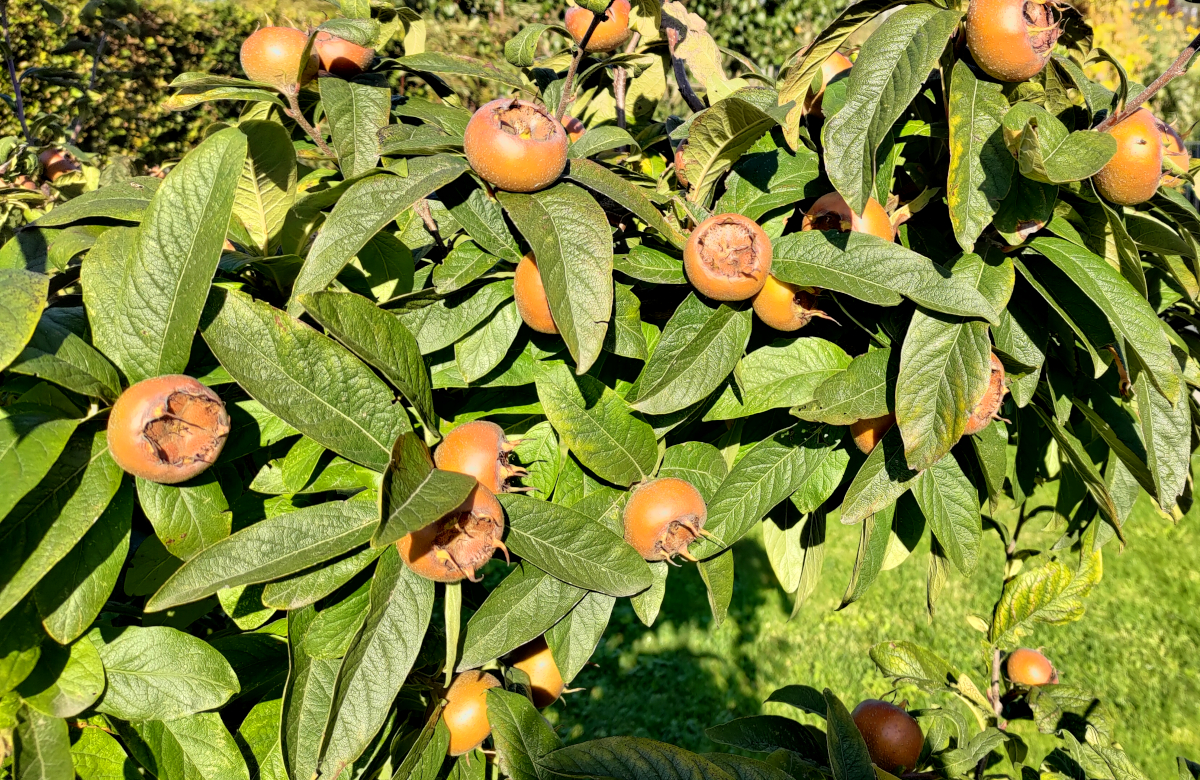
Medlars on the bush
In fruit growing we have apple, pear, mirabelle, plum, renegade, cherry and quince.
I think that's it.
There are also a few wild fruit varieties, mainly cherry plum and also a few medlars, but we don't do anything with them yet.
Note from Aspermühle
You can find more information about medlars in our guide 'Rare and forgotten foods and their importance today'.
You can find more information about medlars in our guide 'Rare and forgotten foods and their importance today'.
Lars Aspermühle:
They are also special in taste and get mushy very quickly.
Henrik van Aken:
They have a great taste in the distillate.
Similar to sloe. When you bite into them, they don't taste particularly good, but as a distillate they are very exciting.
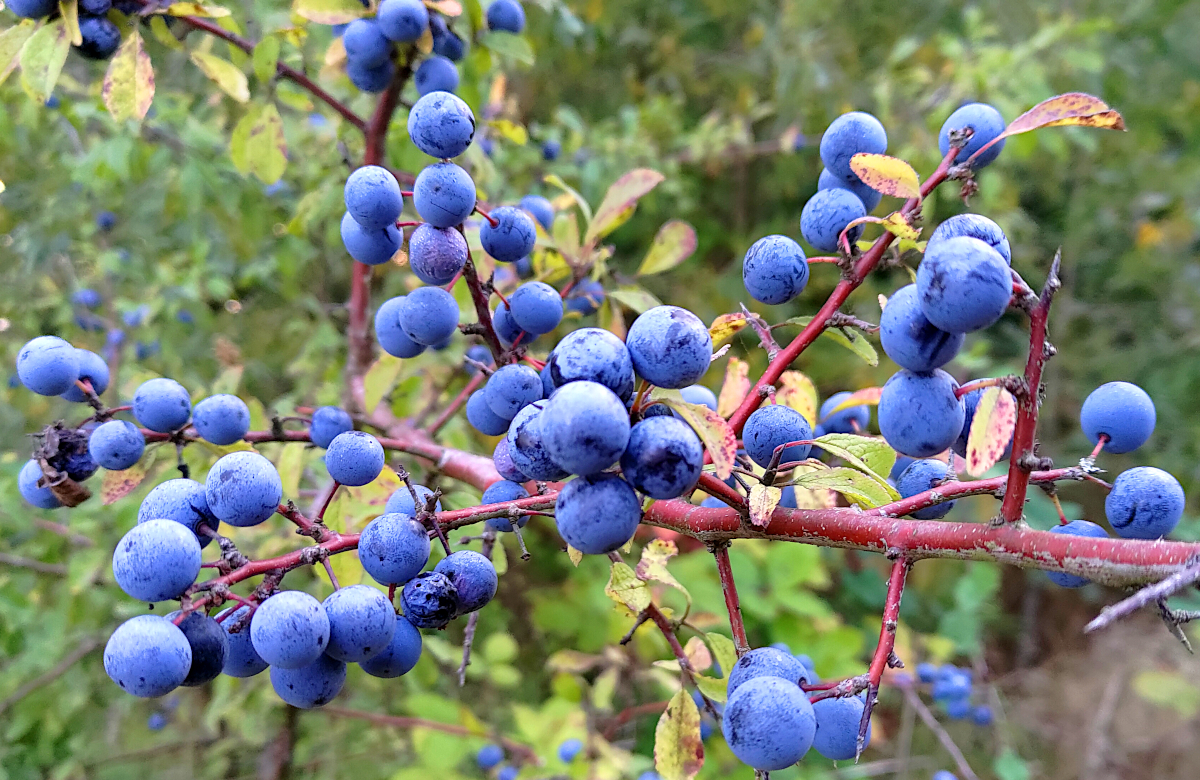
Schlehenstrauch
Lars Aspermühle:
That's right, raw sloe tastes rather strange to get used to, but cooked with sugar and then used as jam, the flavor really comes into its own and it becomes really delicious.
Hendrik van Aken:
Definitely.
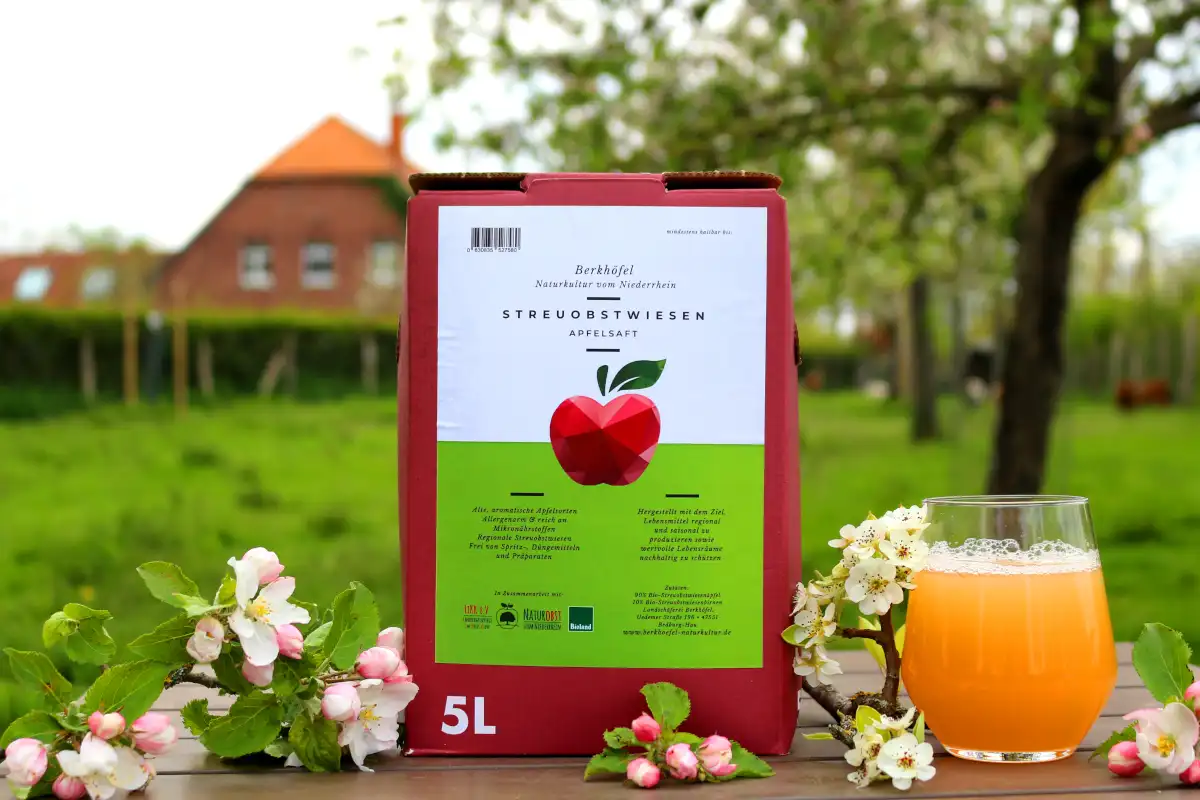
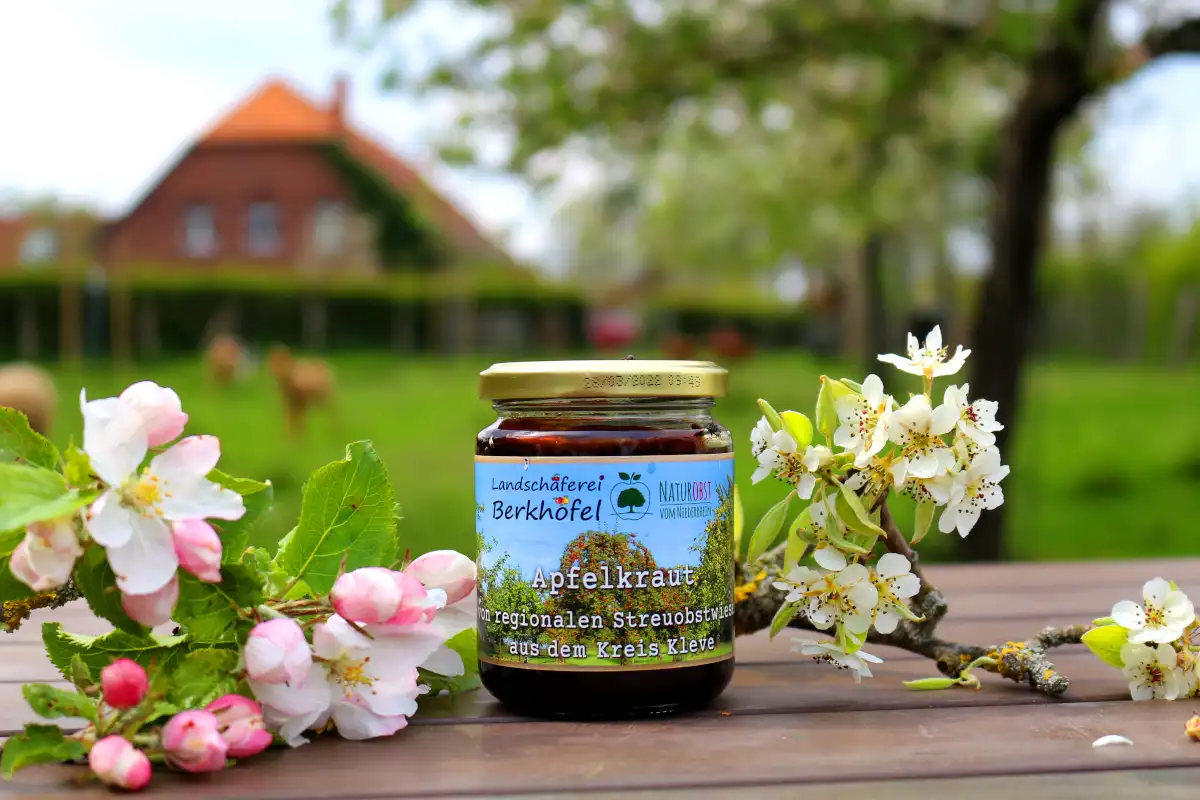
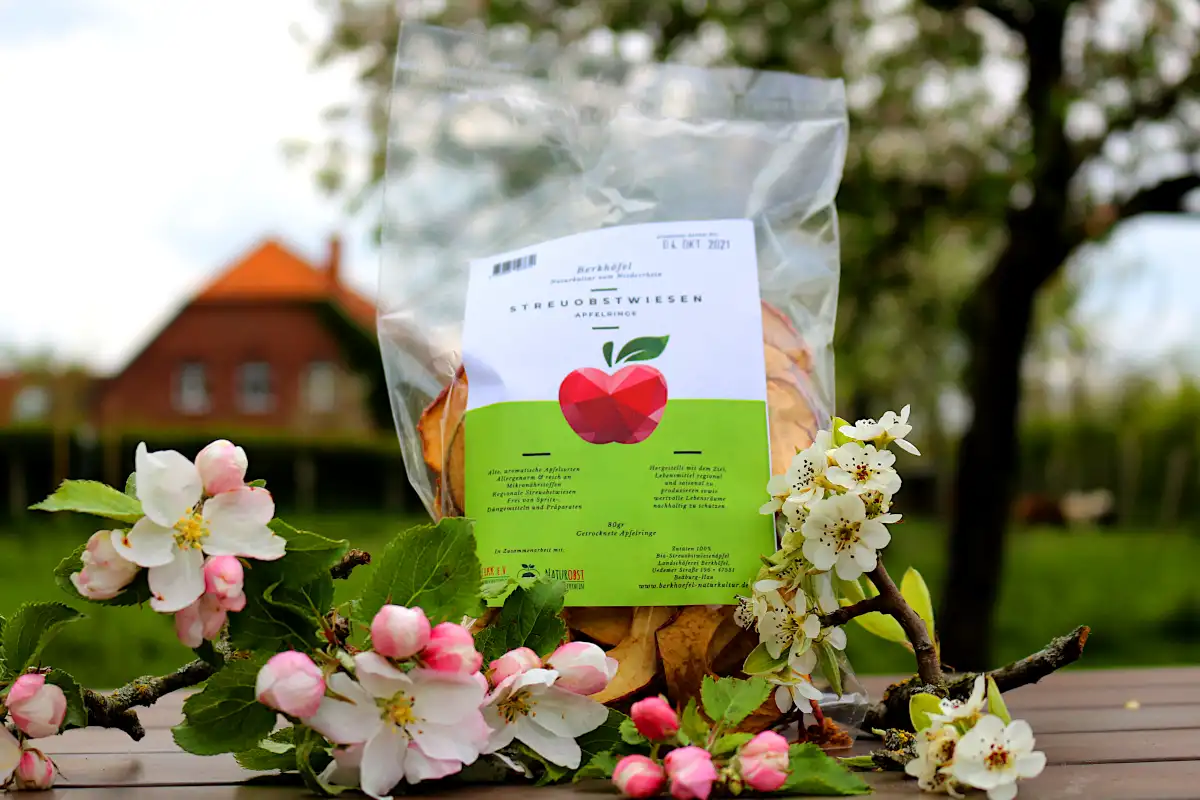
Then we make various things from the fruit.
It's called apple juice and apple syrup. Sometimes also dried apple rings.
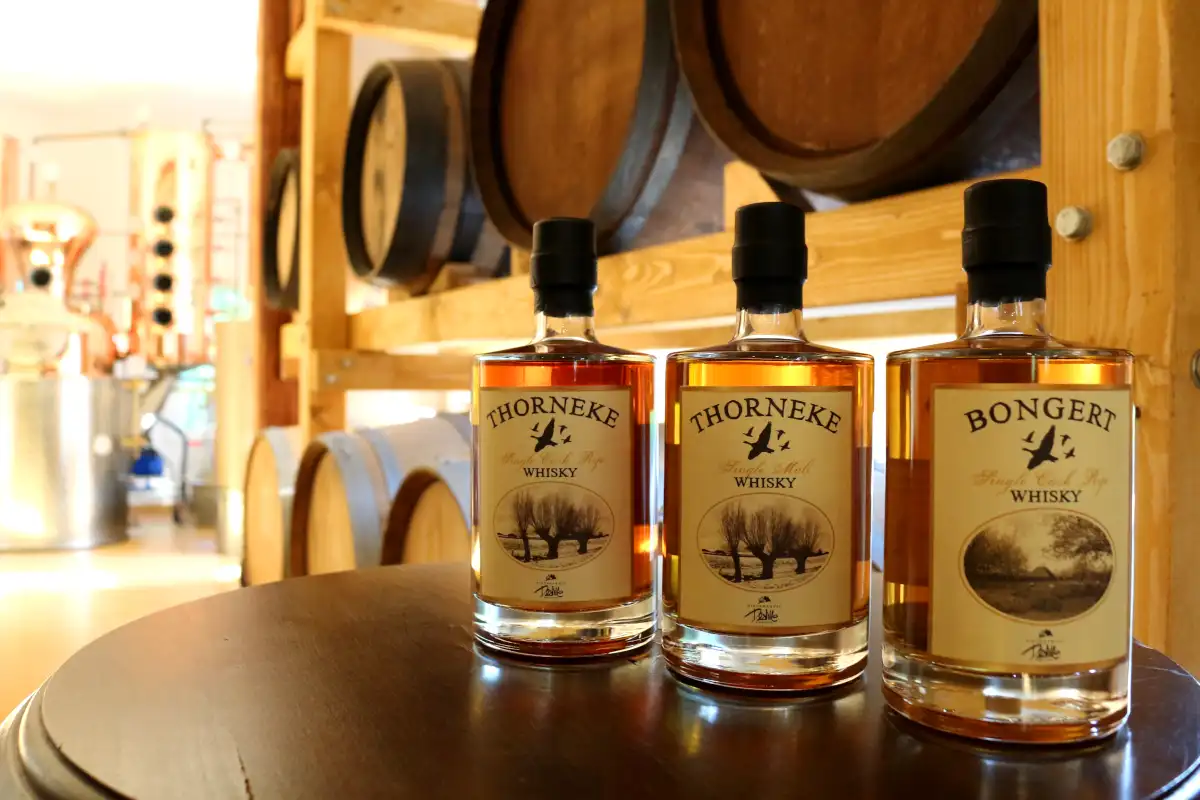
And then, more recently, distillates such as brandies, liqueurs, spirits, whisky and grain, always made from our own raw materials.
Lars Aspermühle:
Perfect, that's how it should be.