Interview with Hendrik van Aken of Berkhöfel Farm, Part 3
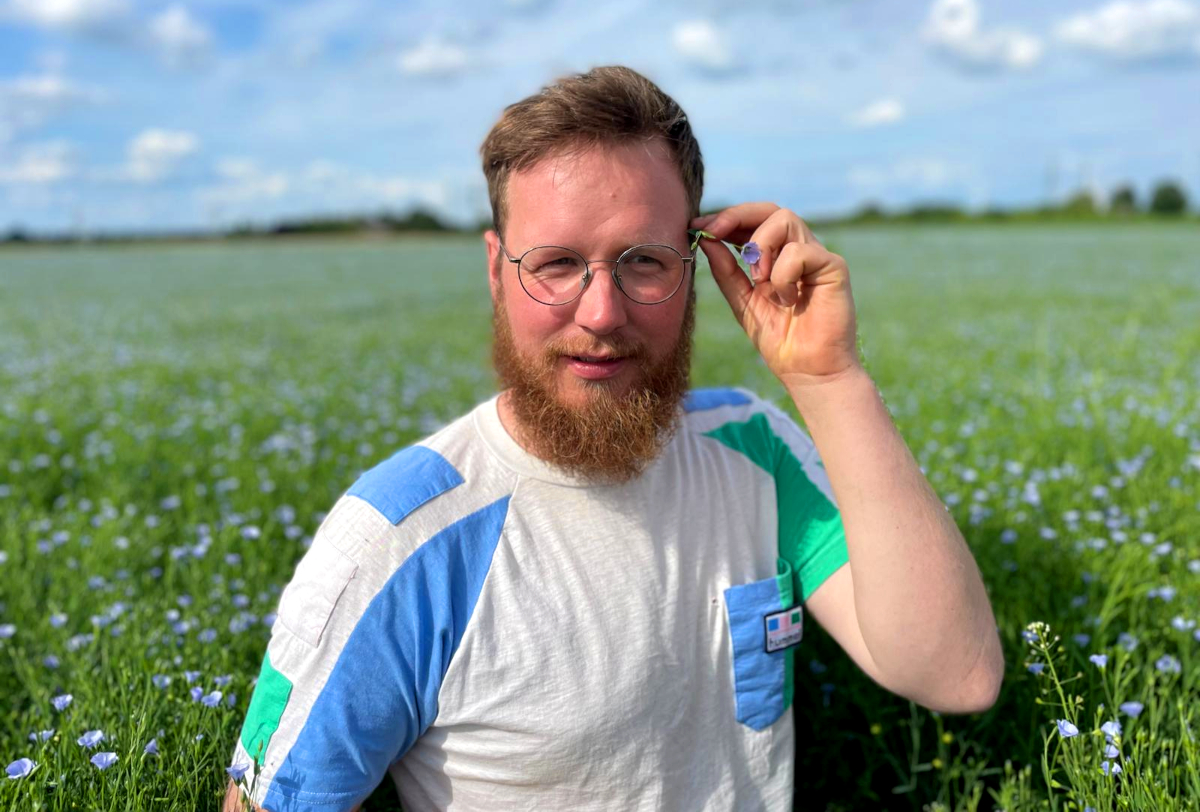
Hendrik van Aken of Hof Berkhöfel
Here is the third part of the interview with Hendrik van Aken from Berkhöfel Farm, also known as the Niederrhein Distillery.
Lars Aspermühle:
Speaking of whiskey, let’s talk about aging techniques: What kind of barrels do you actually use? And where do you source them?
Hendrik van Aken:
We use new white oak, ex-red wine barrels, and ex-cherry barrels. We also use Hungarian Tokaj, and sometimes Amarone from Italy. Plus, we use port wine.
Lars Aspermühle:
Okay, so naturally, those differ significantly in flavor.
Hendrik van Aken:
Yes, the differences really are like night and day.
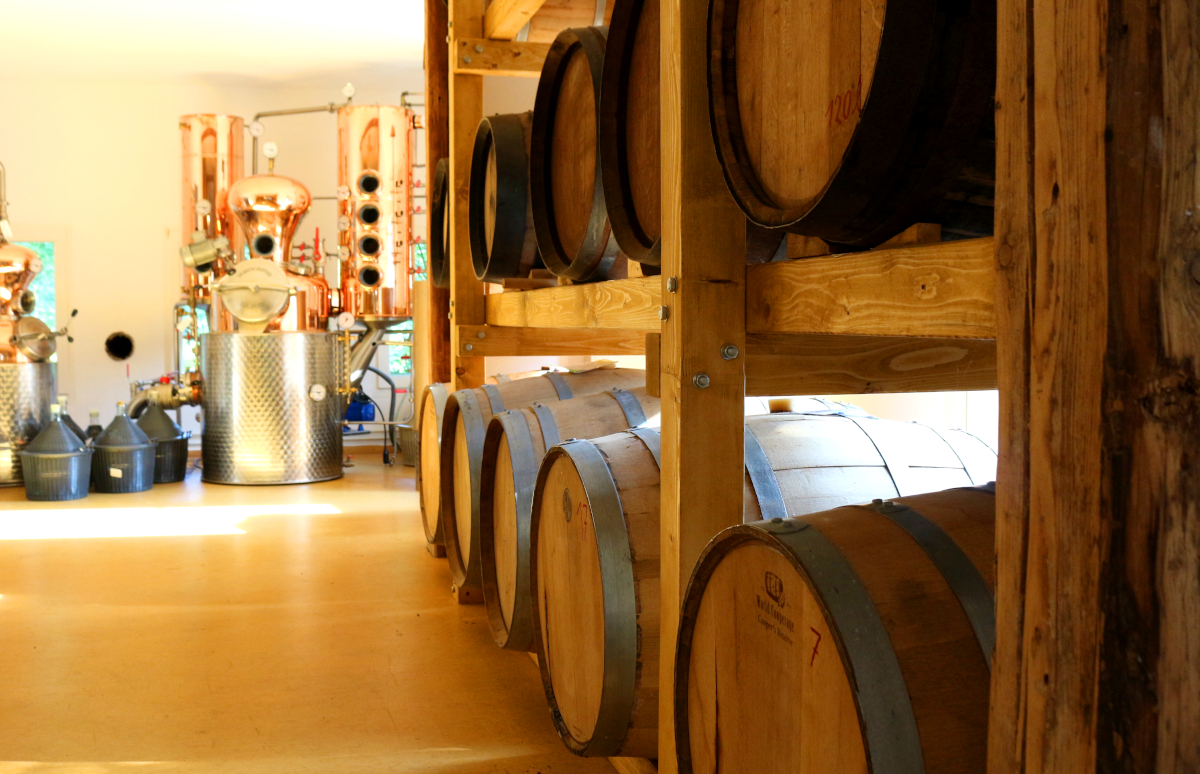
Whiskey barrels at the Niederrhein Distillery
Lars Aspermühle:
Let’s get back to the house project. What’s the situation with the authorities there? They’ll probably need to be involved as well when it comes to building permits or any necessary rezoning, right?
Hendrik van Aken:
No, since the land will continue to be used for agricultural purposes, that generally isn’t a problem. We’ll just have to wait and see for now. We aren’t quite there yet, though. First, the grant application has to be approved, and then we’ll submit the building permit application. The preliminary building permit request has already been submitted and approved.
Lars Aspermühle:
I think the BLE is relatively flexible on such matters. We’ve dealt with them from time to time, and I’ve always found them to be very accommodating.
Hendrik van Aken:
They’re really very nice.
Lars Aspermühle:
Yes, that’s how I felt, too. We dealt with them repeatedly, especially regarding import issues, because things change from time to time in that area. They were always very helpful.
Hendrik van Aken:
Yes, definitely. It’s just a really wonderful project, and the people behind it are incredibly passionate about it. I hope we were able to inspire and motivate them, and that it ultimately works out.
Note from Aspermühle:
BLE stands for the Federal Office for Agriculture and Food. The BLE is a German federal agency responsible for matters related to agriculture, food, fisheries, and rural areas. Its main responsibilities include market regulation, foreign trade, and the oversight of marine fisheries, including the monitoring of catch quotas and the issuance of fishing permits. It is also responsible for the oversight and accreditation of organic certification bodies, for research and funding, and for the collection of statistical data in the food and agriculture sectors.
BLE stands for the Federal Office for Agriculture and Food. The BLE is a German federal agency responsible for matters related to agriculture, food, fisheries, and rural areas. Its main responsibilities include market regulation, foreign trade, and the oversight of marine fisheries, including the monitoring of catch quotas and the issuance of fishing permits. It is also responsible for the oversight and accreditation of organic certification bodies, for research and funding, and for the collection of statistical data in the food and agriculture sectors.
Lars Aspermühle:
I was just thinking about something else because of the building permit. Do you know Marco Scheel, that farmer with the sheep who’s always getting worked up about everything?
Hendrik van Aken:
Yeah. I think he’s dealing with a pretty difficult building department.
Lars Aspermühle:
That’s exactly what I was thinking. I asked myself: What’s going on here? That’s why it popped into my head when I saw the building.
Hendrik van Aken:
At the end of the day, it’s a repurposing project, and that’s generally not a problem. I’m familiar with his videos.
Lars Aspermühle:
I can certainly understand that he wants to bring his ideas to life. At the same time, he’s probably not the easiest person to deal with. You’d likely find him off-putting pretty quickly.
I don’t think he’s particularly easy to get along with.
Hendrik van Aken:
I do think he’s easy to get along with. I just think he gives the impression that he doesn’t want to be told what to do. He has his own ideas, and if someone gets in his way, working with him can probably quickly become unpleasant. Of course, that doesn’t work, especially with government agencies.
Lars Aspermühle:
That’s exactly what I’ve thought sometimes, too. If he took a more relaxed approach to the matter, it would probably work out better.
Hendrik van Aken:
By the way, it’s not exactly helpful to post a YouTube video where you call everyone else “assholes” and then get 20 million views. That probably doesn’t exactly support your own agenda.
Lars Aspermühle:
On the other hand, you’d still say: Of course you might feel attacked by that, but ultimately he’s trying to get something off the ground that actually makes sense.
Hendrik van Aken:
Definitely. And in the end, he even gets someone else on board. That’s really great.
Lars Aspermühle:
That’s true.
Below is a short feature on Marco Scheel and Nordwolle.
Lars Aspermühle:
Wait a minute. We’d actually already touched on the topic of subsidies just now.
Hendrik van Aken:
That’s what we’re subsidized for. We also receive EU funding, both for fruit growing and for crop farming.
Lars Aspermühle:
Exactly. And how much work does all that bureaucracy entail?
Well, I’d say we’re familiar with this from organic certification as well. You have to document a great deal and ultimately provide proof of certain things to the authorities. It really is a lot. For example, certain flows of goods and quantities have to be documented.
Hendrik van Aken:
I’d say that about a quarter of my working time is spent on bureaucracy—and that’s just for that alone. On top of that, there are other things. Some of these aren’t even accounting tasks, but simply documentation work. Agricultural subsidies take up a very large portion of my attention.
Below is a video that addresses the topic of agricultural subsidies.
Lars Aspermühle:
Exactly. But what about your working hours in general? How many hours do you work, roughly?
Hendrik van Aken:
Right now, it’s about 50 hours.
Lars Aspermühle:
Per week?
Per month would be pretty chill. 50 hours is definitely no small amount.
Hendrik van Aken:
Actually, that’s still pretty good.
Of course, it can also be different.
Lars Aspermühle:
Yeah, sure. But if you compare that to, let’s say—in quotes—“a normal job” where you work 38 hours a week, that’s actually quite a bit more.
Hendrik van Aken:
Yeah, sure. But I’m also the CEO.
Lars Aspermühle:
Exactly, that’s obviously a key point. And I think what people often don’t realize is that the job doesn’t necessarily end when the workday is over. I know this from my own experience, too. For example, I’ll say, “I’m going to take the dog for a walk now,” and while I’m out, I’m constantly thinking about various things, making phone calls, sending messages, or organizing something.
Hendrik van Aken:
Yeah, the phone just never stops ringing.
Lars Aspermühle:
Exactly.
Hendrik van Aken:
Well, it’s manageable right now. I think 50 hours is really fine at the moment. Of course, there are also times and seasons when it’s significantly more.
Lars Aspermühle:
Okay, probably during harvest season?
Hendrik van Aken:
More, yes. When there’s extra work to do in the fields, you can end up spending a day or two in a row on the tractor. Then, of course, the hours add up. But right now, it’s really manageable.
Lars Aspermühle:
Okay.
Hendrik van Aken:
Yes.
Lars Aspermühle:
Well, of course, it also makes a difference whether it’s positive or negative stress. If you’re doing something you say, “I really enjoy this,” it’s probably less of a problem. It’s a different story if you constantly have to work against something that’s incredibly annoying.
Hendrik van Aken:
Yes, exactly.
Lars Aspermühle:
But do you actually still have time for vacation, or would you say that in this case it’s not that important to you?
Hendrik van Aken:
Yes, vacations are important to me. I do take my vacations. By the way, it’s interesting how differently this is handled in agriculture. It varies considerably from one farm to another. Some farms say, “That’s out of the question.” To be honest, I think that’s absolute nonsense. Maybe I’m not quite as successful financially because of it. Maybe a crop will fail once in a while because I happen to be on vacation or something.
Maybe I’m also in a somewhat privileged situation because I come from a different background. I’m actually a career changer who entered the agricultural sector.
The following video explains how taking a vacation is possible in agriculture.
Lars Aspermühle:
And you were able to build your farm pretty much the way you wanted it, rather than coming from an already established farm where you first had to ensure that it operated profitably and generated the necessary income?
Hendrik van Aken:
Exactly. But it’s also simply the case that, for example, dairy farming is a completely different field where you actually have to be constantly present.
But here’s how I see it: If we as an agricultural profession want to survive in the long term in our modern civilization, then we have to set an example for the next generation. We need to show our employees that it’s possible to be a business owner and still lead a normal life—one where, for example, you can go on vacation once in a while. After all, for most people, it’s completely normal to take a vacation two or three times a year.
Lars Aspermühle:
Yes, otherwise production will probably become difficult at some point. If, at some point, you can’t find anyone who says, “This is interesting to me, even if it’s a 24-hours-a-day, 7-days-a-week job where I have practically no personal free time left,” then eventually people will say, “I’m not interested.”
Hendrik van Aken:
That might not be the case for me yet. But when the next generation comes along—that is, when you have children—then it’s also a question of the example you set for them. If they see that you’re never around and never go on vacation, that naturally shapes them. But there’s absolutely nothing wrong with not going on vacation once in a while
After all, you can have a great time at home, too.
I don’t mean to imply that I think this is a bad thing. I’m familiar with the situation on many farms, and I really take my hat off to the people who work there. They handle an enormous workload.
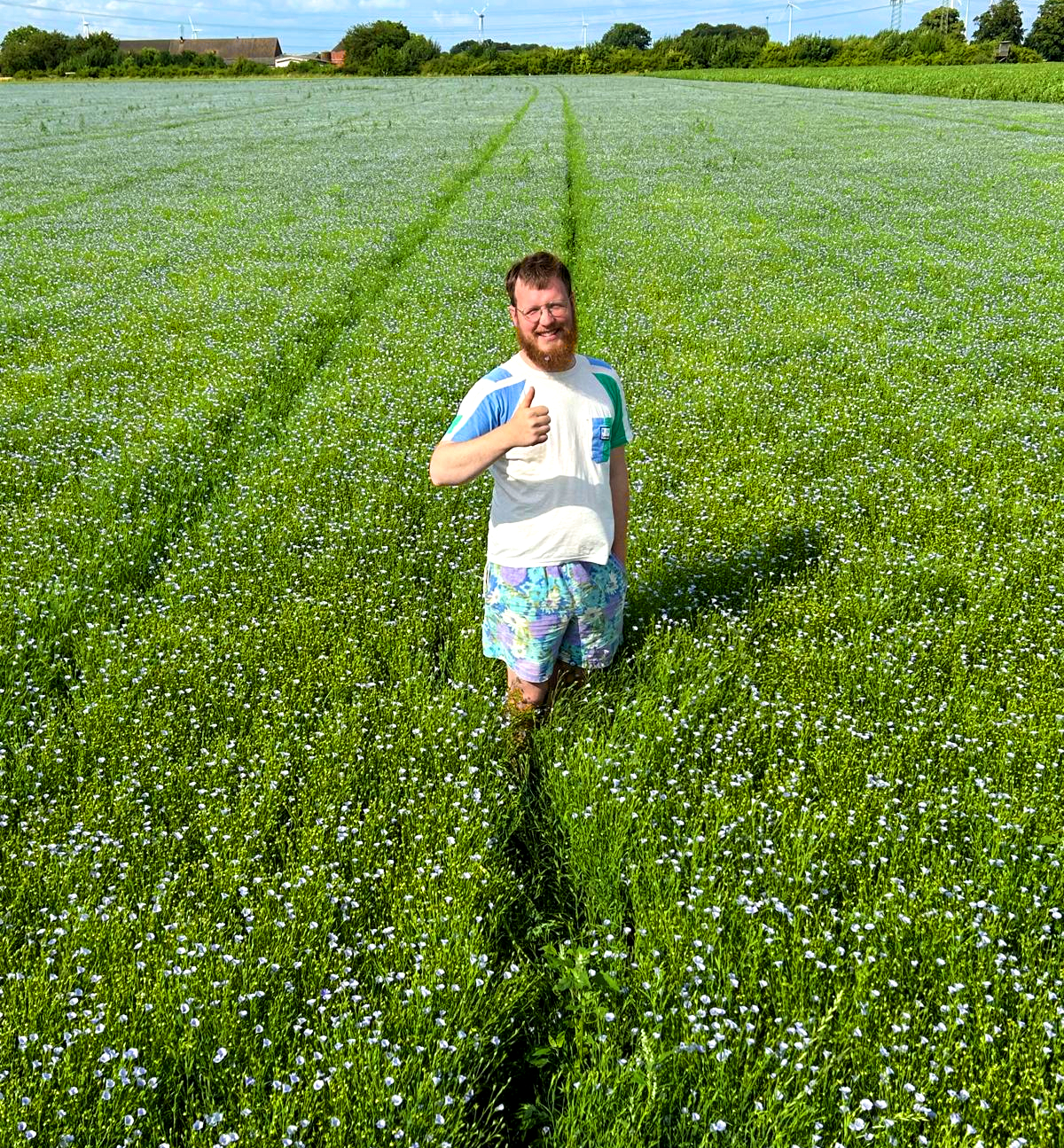
Hendrik in a vacation mood
But we also see that the younger generations often aren’t interested in following in their footsteps. At school, the children see what’s considered completely normal for others: During Easter break, you go on vacation; during summer break, you go somewhere for two or three weeks; during fall break, you might go away again; and in the winter, you go on a ski vacation.
Of course, the children pick up on this because they see that all their friends are doing these things, while they themselves stay at home on the farm. And maybe at some point, they won’t find it as much fun anymore. Then I can understand why some teenagers or children might eventually develop a certain resentment and say, “That’s actually not my dream.”
That’s exactly what we’re consciously trying to instill here. It’s not just okay to go on vacation—it’s good to go on vacation. You have to take a break once in a while.
I notice this in myself. I’m not exactly the most stress-resistant person. I have a certain threshold that I can handle well. Once I reach that threshold, I need to get away for a while. And if I don’t do that, it eventually takes a toll on my mental health.
Lars Aspermühle:
I understand. That’s the case for most people.
Hendrik van Aken:
Yes, of course there are also people who can just keep going. Maybe that eventually shows up in other areas of their lives. In any case, I have my own issues that I have to keep an eye on. My mental health has its challenges, so I have to pay close attention to it. Sometimes I just have to say, “Okay, damn it, I’ll just have to let a few things slide for now.”
Lars Aspermühle:
It’s good to be able to do that, after all.
Hendrik van Aken:
Yeah. Over many years, I’ve experienced what it’s like when you can’t do that, and fortunately, I’ve learned from it. By now, I’m pretty good at recognizing when I’m reaching my limits and then consciously stepping back. That’s just what you have to do.
That happened to me again a few weeks ago. At some point, I thought, “Man, I can’t really pull this off.” But I’d already planned my vacation. I go to France every fall—almost without fail. There were a few years when I didn’t go, and looking back, that really annoyed me. You need that break to clear your head.
This year I went, and everything still worked out wonderfully. I just came back a day early because things were really heating up. But after that, everything was fine again.
Lars Aspermühle:
It’s the same for us. We’ve had a few years now where I felt like it was just too much. You can’t escape it and feel like you have no way to change anything. This year, things got a little more relaxed. We started restructuring a few things, and things have actually gotten a bit better since then.
Hendrik van Aken:
Yes, that’s an important issue. It’s also about delegating responsibility and trusting that others will handle the tasks just as reliably. At the same time, though, you also have to be able to delegate responsibility sensibly.
Of course, I could just walk away and say, “You’re in charge now.” But that’s not how it works. It has to be structured. You have to create the structures so that someone else can actually take on that responsibility and carry out the corresponding tasks.
For example, our apprentice was supposed to take on certain tasks at one point. In hindsight, I realized that I hadn’t prepared her sufficiently for it. You have to admit that to yourself and make the necessary adjustments. You have to make sure you prepare the people around you adequately so that, when you’re not there, they can still do what’s expected of them.
That’s definitely an important issue.
Lars Aspermühle:
But perhaps part of it is also learning to accept that employees don’t share the same perfectionism.
Yes, of course.
Hendrik van Aken:
Yes, of course.
Although I don’t actually have that perfectionism myself. But you also shouldn’t overwhelm yourself with what you’re leaving behind. Because there’s already quite a lot that’s constantly on your mind.
I think some people forget that sometimes—that a CEO’s mind is already pretty full. And when all these things come crashing down on someone who doesn’t normally bear that responsibility, you realize just how many individual tasks there actually are.
That’s why you also have to learn to consciously let some things go. Otherwise, you’ll drive yourself crazy at some point.
Lars Aspermühle:
I notice that in our company, too. We have so many different areas that the tasks vary greatly from one another. First, there are the simple things like packing packages and products. Then, of course, there’s the office side with customer service, emails, and similar tasks.
At the same time, though, you also have to handle things like organic certification and orders. On top of that, there are legal issues you need to keep an eye on: How up-to-date are your terms and conditions? What about the right of withdrawal? Are there any changes in EU law, for example? And then there are tax-related issues and much more on top of that.
That’s all pretty extensive already. And if you have an employee who exclusively packs packages, they naturally have a completely different set of responsibilities.
That’s definitely extensive.
Hendrik van Aken:
So yeah, I’m taking a vacation.
Lars Aspermühle:
That’s good.
Back to the topic of seeds. Do you produce your own seeds?
Hendrik van Aken:
It depends. Especially with grains, it’s not that simple. If, for example, you have a pathogen in your crop—and that can certainly happen in organic farming—it’s obviously a problem. If you have rust or powdery mildew in your crop, you have to rely on seed from other farms.
So it’s certainly helpful that there are seed propagation facilities that produce clean seed you can rely on.
We use our own seed if we’ve had a healthy plant. Then we replant with it. If something didn’t go right, we order new seed.
We’re also pretty set on our varieties. With flaxseed and einkorn, for example, we’ve been using our own seed for years. With rye and wheat, however, it’s a different story. We actually use those seeds for no more than two years. Most of the time, we grow a single crop with them and then order new seeds.
Otherwise, the yield or crop health will no longer be satisfactory.
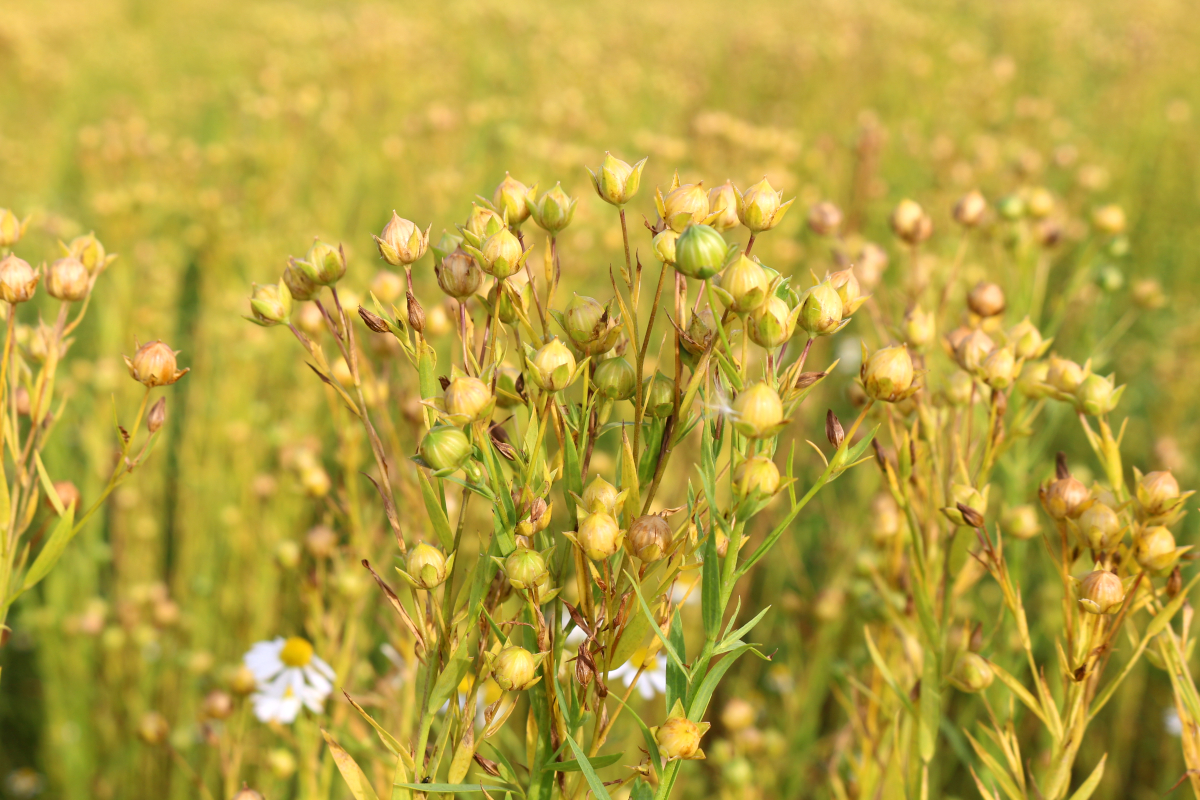
Flaxseed capsules
Lars Aspermühle:
So even if you have a healthy plant, it wouldn’t necessarily make sense to use the same grain every year for the next planting?
Hendrik van Aken:
If the crops are completely healthy every year, you could do it.
For example, I once had rye that I grew for four years in a row using the same seed. But eventually, there was a year when things went really wrong.
Lars Aspermühle:
Okay, and then you have to use new seed again?
Hendrik van Aken:
Exactly, then you have to resow.
Lars Aspermühle:
I’m just thinking: That was probably difficult back then, too, when people were facing famine and couldn’t afford to buy new seeds, for example. If you had a bad harvest, you’d have a problem for the next year as well.
Hendrik van Aken:
And that makes it all the more important to have another good, dry, and high-yielding year.
It’s a good thing we have seed production facilities. They make an important contribution to food security.
Lars Aspermühle:
Exactly. So, hold on a second—I’ll stick with plants for a moment, because I also wanted to come back to the topic of sheep. Fertilization—exactly: plant fertilization.
Do you guys do that? And if so, how?
Hendrik van Aken:
Yes. In the fields, we use sheep manure and cattle manure. The cattle manure, however, is used exclusively on the wheat and feed barley. That’s about it. Rye, einkorn, flaxseed, and field beans are fertilized exclusively with sheep manure.
Lars Aspermühle:
Okay. So do you collect the manure from your pastures, or do you let the sheep graze there?
Hendrik van Aken:
No, it varies. For one thing, the sheep graze on areas with cover crops. Between the main crops, for example, we grow oil radish, clover-grass, or regular grass, which the sheep then graze on.
When the sheep are in the barn during lambing season, manure is naturally produced as well. This is then spread on the fields.
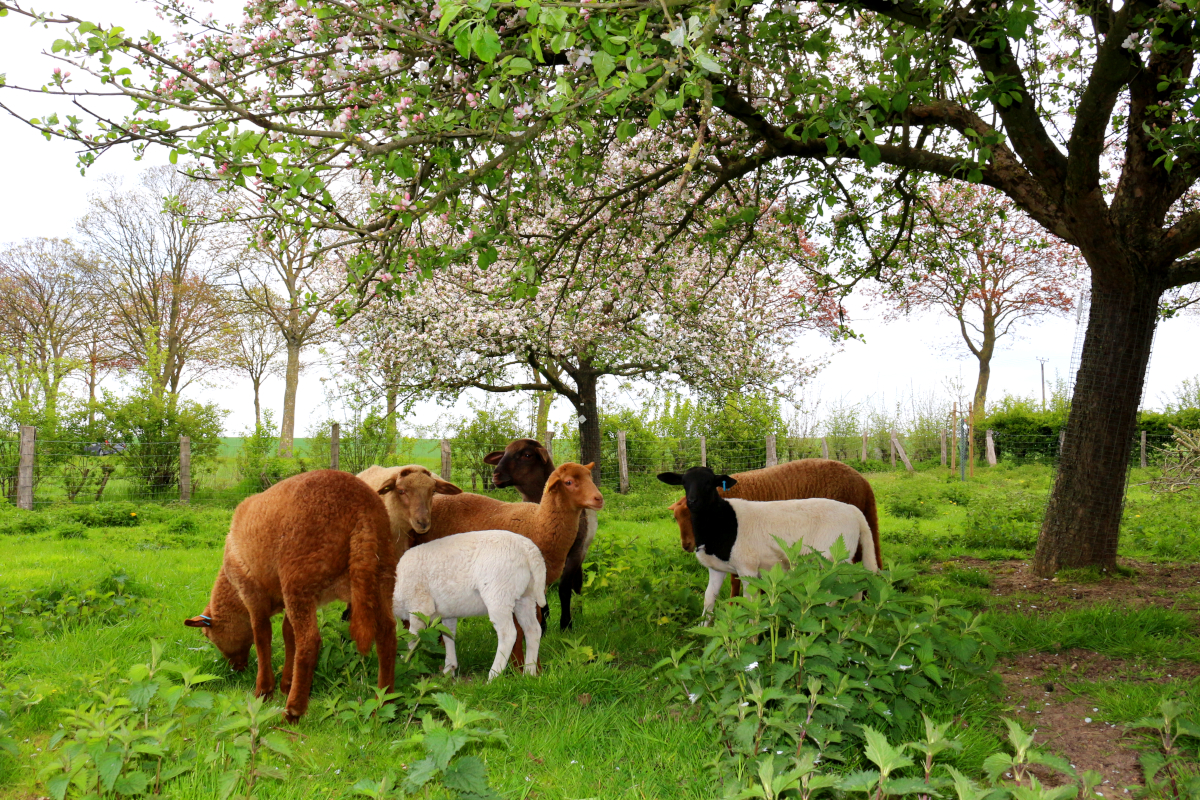
Sheep for fertilization and pest control in the orchard meadow
Lars Aspermühle:
So we’ve already covered the topic of pest control in theory. Nothing really happens on your farm in that regard.
Except for the cherries, which get eaten.
Now on to the topic of pollination: Do you take any additional measures for this, or do you use bee or bumblebee hives, for example? That’s something you see in some places. I’ve seen it, for example, in tomato greenhouses, where bumblebees are specifically introduced.
Hendrik van Aken:
We don’t do that. In fact, we take the exact opposite approach here. In our view, domesticated bees—or honeybees —reduce the habitat available for wild bees. This runs counter to what we’re actually trying to achieve with the orchard meadows. They’re meant to create habitats for wildlife, including insects.
That’s why our approach is exactly the opposite: We actually don’t want to have domesticated bees in the orchard meadows because we’re only providing a relatively small habitat for the animals there anyway. And we’re already dealing with bee decline and similar issues.
That’s why we say: In such a near-natural habitat, we don’t need additional domesticated bees.
I see things differently when it comes to croplands. There, we have two, three, or four tillage passes per year, which naturally results in greater interference with the habitat. At the same time, however, we also have a very high abundance of flowering plants there. In these areas, the use of bees could, in turn, be beneficial.
Currently, however, it’s not yet necessary for us. So far, I haven’t had the impression that we’re lacking pollination services anywhere. But that would be a topic I’d say I’d find exciting to explore in more detail.
With rapeseed, for example, this is quite interesting. It’s quite common there to place bee colonies on the fields. With other crops, we haven’t done that yet because we aren’t dependent on a specific level of pollination to the same extent.
In fruit farming, too, many people keep insisting that we should use additional bees. I don’t see it that way, though. When I’m out in our orchards harvesting, there’s a constant buzzing and humming all around. That’s why I see it exactly the other way around: I want to support the natural populations and not put them at additional risk. For me, beekeeping makes sense in places where wild populations aren’t doing so well.
Below is a short report on the orchard meadow as a habitat.
Lars Aspermühle:
Rapeseed would, of course, be the best example.
Yes, though I have to say again that rapeseed honey isn’t really anything special. Of course, I’m saying this from the perspective of someone who sells honey, because I figure: I don’t really need rapeseed honey in my product line. First of all, you can get it everywhere, and second, in my opinion, it just doesn’t taste very good.
Hendrik van Aken:
Interestingly, we just did an experiment. We have chestnut honey, early-season honey, and rapeseed honey. The rapeseed and early-season honeys are infused with Williams pear, and the chestnut honey with whiskey. So far, I like the rapeseed honey with Williams pear best. Somehow, they go better together.
I actually find the early-season honey even more delicious in terms of flavor, but in this combination, I liked the rapeseed honey with Williams pear better.
Lars Aspermühle:
Interesting, exciting. The rapeseed honey has a relatively strong sweetness. Aromatically, it’s rather subtle, but very sweet.
Hendrik van Aken:
Exactly. The other types of honey tend to mask the Williams pear, while the rapeseed honey brings out the Williams pear even more. There’s a place for everything where it can be used effectively.
Lars Aspermühle:
Exactly. That’s actually what you should suggest to beekeepers: “Don’t sell it in the store—put it in alcohol instead. Put it in the Williams pear. Then it’ll taste good, too.”
Now, on the topic of agroforestry—since we were just talking about trees and biodiversity—is agroforestry something you’re involved in?
Well, orchard meadows and agroforestry aren’t necessarily the same thing. They’re actually different concepts.
Hendrik van Aken:
Scientifically speaking, they’re the same thing.
So, a mixed-fruit orchard is always an agroforestry system. But an agroforestry system can take many different forms—including, among others, a mixed-fruit orchard.
A mixed-fruit orchard is what’s known as a silvopastoral agroforestry system, to put it in somewhat fancy terms.
Note from Aspermühle:
In our guide article “Wild Bees in the Agricultural Landscape” by Anna-Lea Ortman, you’ll find detailed information on the importance of agroforestry systems as habitats for diverse insect populations.
In our guide article “Wild Bees in the Agricultural Landscape” by Anna-Lea Ortman, you’ll find detailed information on the importance of agroforestry systems as habitats for diverse insect populations.
Lars Aspermühle:
Good to know. What does that mean in the end?
Hendrik van Aken:
“Silvopastoral” means there is a forest component, and grazing takes place beneath it.
Lars Aspermühle:
Okay. So it doesn’t necessarily mean that something else is also being grown there?
Hendrik van Aken:
Yes, although grass is, of course, also a crop.
Lars Aspermühle:
That’s true.
Hendrik van Aken:
This is a cultivated system we’ve established there. It’s a human-created land-use system that doesn’t occur naturally in this form. The primary vegetation layer is the permanent grassland at the bottom. Above that, as a second layer, is a forest-based system consisting of fruit trees. This is a silvopastoral agroforestry system.
Along with hedgerows, this is one of the most widespread agroforestry systems. But of course, that’s not what agroforestry generally refers to.
Below is a video about the use of agroforestry systems.
Hendrik van Aken:
For example, we also integrate scattered orchard systems into arable farming, where traditional crops continue to be grown.
Lars Aspermühle:
In strips?
Hendrik van Aken:
Yes. In these strip crops, standard trees are planted within the fields. We established a pilot system like this four years ago, and next week we’ll be setting up a second one—this time with a mixed stand of standard and dwarf trees within the strips.
This is a topic that, in my opinion, will remain relevant: hedge crops or, more generally, strip cropping in arable farming. It’s a similar topic to malt. We could actually do an entire interview on that as well.
Ultimately, it’s about increasing the resilience of the fields, creating windbreaks, providing more shade, and retaining water in the fields.
Lars Aspermühle:
Exactly, retaining water in the fields is definitely important here.
I think sea buckthorn is a very good plant for that.
Hendrik van Aken:
For that, though, you need the right soil. The name says it all. It grows best in sandy soils and isn’t exactly thrilled with heavy soil.
Lars Aspermühle:
It’s a plant that manages water very well and can store it accordingly. So sea buckthorn is ideally suited for this.
I also mentioned a project in one of our how-to articles where sea buckthorn was specifically used to restore vegetation and a river channel on heavily eroded soils. There, it actually absorbed and stored an enormous amount of water.
Note from Aspermühle:
In our guide article “Native Superfoods and Edible Wild Plants
,”In our guide article “Native Superfoods and Edible Wild Plants
you’ll find more detailed information on how to protect eroded soil with the help of sea buckthorn bushes.
Hendrik van Aken:
That’s a huge topic in and of itself. We’re working on it very intensively because I want to transition our land to sustainable farming practices. It’s important to me that we’ll still be able to farm it in 20 or 30 years and that it doesn’t eventually turn into a sandy wasteland.
Lars Aspermühle:
Exactly—which actually brings us right to the topic of climate change and the question of how to prepare for it.
Hendrik van Aken:
Agroforestry is a key factor here. I’m currently writing my master’s thesis on no-till farming. As part of the thesis, we have to carry out two practical projects.
The first project runs for twelve months. In it, we’ll monitor a crop—in this case, bread wheat —and examine how it develops under organic farming practices compared to our conventional tillage methods using a plow. So we’re contrasting that with a no-till approach.
Lars Aspermühle:
Does this actually bring us into the realm of permaculture?
Hendrik van Aken:
No, permaculture is something else entirely. If you’re just referring to the fact that the soil isn’t broken up, then that’s certainly an aspect that also plays a role in permaculture. But we’re still a long way from that.
After all, we’re still tilling large areas of land with heavy machinery. So I’m certainly not going to start doing without my tractor.
Lars Aspermühle:
Yes, that makes sense. Especially given the scale of your operations, it probably wouldn’t work otherwise.
Hendrik van Aken:
Of course, I could also hire 200 employees and grow other crops, but then we’d be in the specialty vegetable business or something similar.
Lars Aspermühle:
Yes, and that brings us back to the topic of labor costs.
Hendrik van Aken:
Yes. To be honest, I have absolutely no interest in that. I have great respect for anyone who grows vegetables, but you can really forget about me doing that. Fertilizing and weeding—those are my absolute worst enemies.
Lars Aspermühle:
That’s more what Community-Supported Agriculture in Kleve does.
Hendrik van Aken:
Yeah. My dad has been trying to get me excited about it my whole life, anyway. I really like eating vegetables—I even love them—but...
To be continued in Part 4.